 Blog
Blog
Light and shadow in modern painting
Stages of evolution from the Renaissance to the present day
Part 1
Have you ever stood in front of a painting and felt as though you were being drawn into its atmosphere? Much of this effect lies in the way the artist has used light.
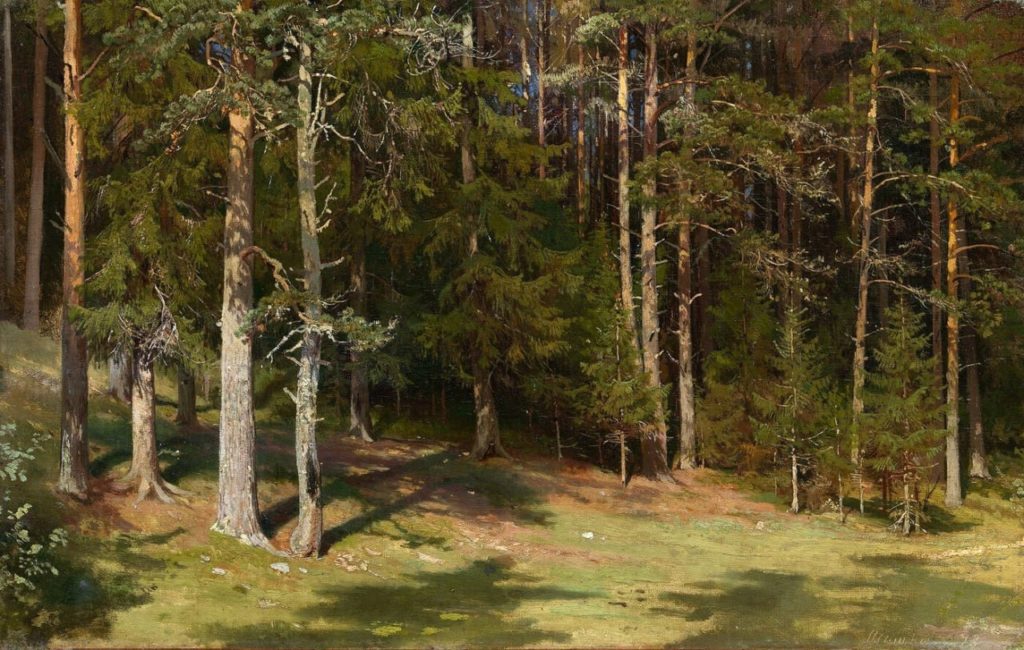
Ivan Shishkin (1832–1898), “Forest Glade”, 1878, Oil on canvas; 35.5×55.5 cm, Private collection
Light is not merely a technical element of painting; it is a powerful tool in the artist’s hands, capable of evoking emotions, shaping perception and guiding the viewer’s gaze.
From Caravaggio’s dramatic shadows to the sunlit radiance of the Impressionists, light has always played a key role in the evolution of modern painting.
Let’s take a look at how artists from different periods used light to examine modern painting and our experience of it from a slightly different angle.
Chiaroscuro: Caravaggio’s bold breakthrough
Towards the end of the 16th century, the Italian artist and reformer of 17th-century European painting, Michelangelo Merisi da Caravaggio—one of the most prominent exponents of realism in Baroque painting—stunned the art world with his chiaroscuro technique¹—a striking contrast between light and shadow.
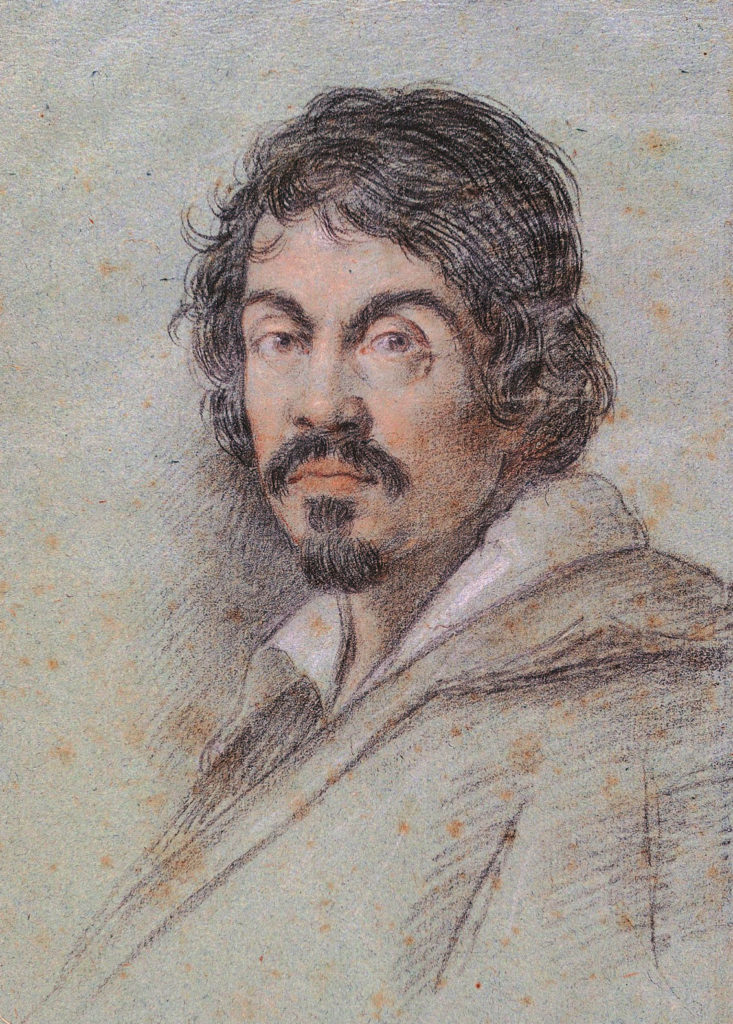
«Portrait of Caravaggio» c. 1621
Ottavio Leoni (1578–1630)
The drawing is executed in black chalk and pastel on blue paper.
The portrait is posthumous. It was created approximately 11 years after Caravaggio’s death, likely based on Leoni’s personal recollections or earlier sketches, as both artists lived and worked in Rome at the same time.
The original is held at the Marucelliana Library in Florence, Italy.
Unlike the earlier Renaissance masters, who favoured harmonious compositions, Caravaggio placed his subjects at the centre of attention, as if they were actors on a stage. This approach heightened the emotional tension and realism.
He often placed his figures in near-darkness, allowing only a single beam of light to illuminate a gesture or facial expression. This radical use of light brought mythological and historical scenes closer to real life, drawing the viewer into the action depicted in the painting and encouraging them to empathise and engage emotionally with it.
In his famous “Guide to the Picture Gallery of the Imperial Hermitage”, published in 1910, the eminent artist and art historian A. N. Benois wrote that ‘Caravaggio understood Leonardo’s subtle doctrine of light and shadow in the simplest way and began to paint pictures in which people and objects are truly depicted, bathed in bright white light that casts thick, dark shadows. The impact of these paintings amidst the saccharine, mannered art of various eclectics was stunning, and the resounding success of this formula convinced the inventor himself that true painting—a genuine rivalry with nature—began with him. Something similar occurred in the mid-19th century, when Courbet emerged to replace the dying academic tradition.”
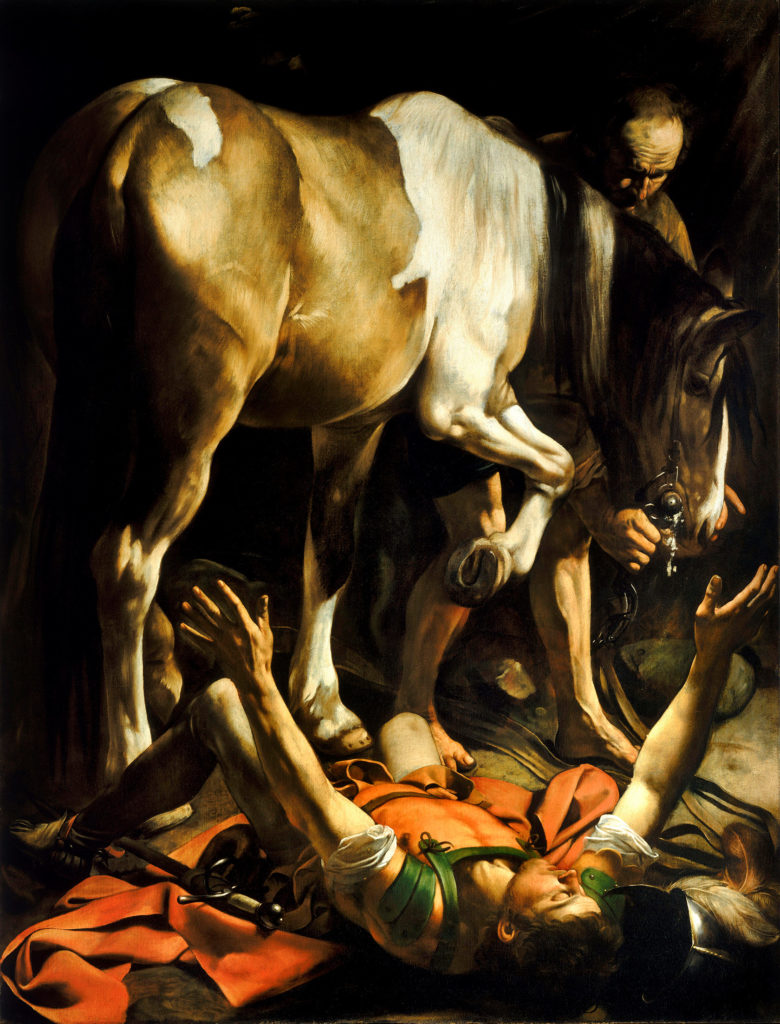
«Conversion on the Way to Damascus» (1601) by Caravaggio Oil on canvas, 230 x 175 cm (90.5 x 68.8 in).
Cerasi Chapel, Santa Maria del Popolo, Rome
At the beginning of the 20th century, art historian Matteo Marangoni assessed this artwork as follows: ‘The painting «The Conversion of Saul» is the greatest milestone in modern art, not so much because of its powerful realism, but rather thanks to its new, revolutionary language and style. Caravaggio was indeed the first to look at life with open eyes, free from the blinders of any secular cultural and intellectual tradition, from which even Titian had not entirely broken free. This horse of his was seen for the first time through the artistic eye of a 19th-century Impressionist.”
«Admirers of Caravaggio’s art saw him as a reformer of religious painting. Caravaggio’s large-scale paintings, based on Gospel stories, were striking for their naturalism, their sense of illusion, and their powerful, populist spirit. To the classicism that prevailed at the time—which followed the artistic traditions of Raphael and the official Catholic Baroque, the «sweetened and sentimental style of Catholic idealism» of Bartolomeo della Porta, and the nascent Mannerism, the provincial master with an unbridled temperament boldly set his own naturalistic method in opposition, based on close-ups, daring angles, and chiaroscuro effects.” (Vlasov, V. G. Caravaggism // New Encyclopaedic Dictionary of Fine Arts)
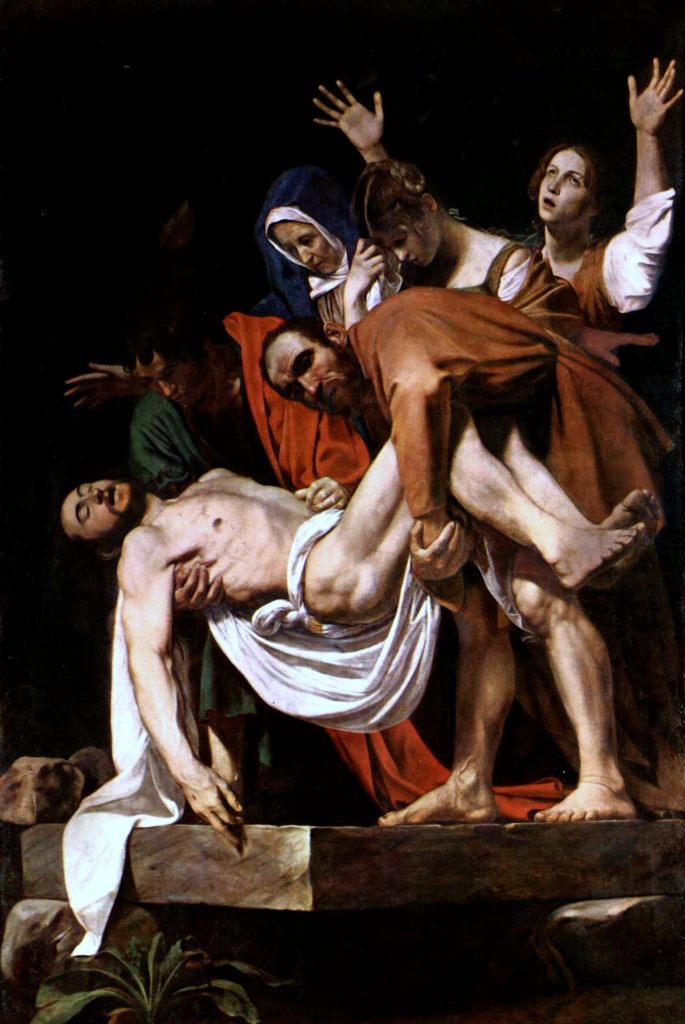
«The Entombment of Christ» (1602), by Caravaggio, oil on canvas, 300 × 203 cm, Vatican Pinacoteca
Caravaggio painted his masterpiece The Entombment in 1602 for the Church of Santa Maria in Vallicella. This painting was to be copied by many artists, from Rubens to Cézanne. Some scholars believe that the figure of the Pharisee Nicodemus is a depiction of Michelangelo.
The light draws the figures of the characters out of the darkness of the painting’s almost black abstract background (the famous ‘Caravaggesque chiaroscuro’), lending the entire scene a tragic and, at the same time, intensely mystical atmosphere.
The composition of Caravaggio’s painting is sculptural, or rather, verges on high relief. The group of figures is monolithic, and this has led critics to compare it with Michelangelo’s sculptural ‘Pietà’ in St Peter’s Basilica or his ‘Florentine Pietà’ (in the Museum of the Cathedral, Florence). This may explain, albeit rather hypothetically, the appearance of a portrait of Michelangelo in the figure of Saint Nicodemus.
Caravaggio’s art had an enormous influence not only on Italian artists but also on the leading Western European masters of the 17th century—Rubens, Jordaens, Zurbarán and Velázquez. This style, which was innovative for its time, gave rise to a new movement in painting—‘tenebrism’ 2) and inspired entire generations of artists, including Rembrandt and the late Renaissance French artist Georges de La Tour, who painted pictures in which the figures are illuminated by a hidden light source or a burning candle casting fanciful shadows.
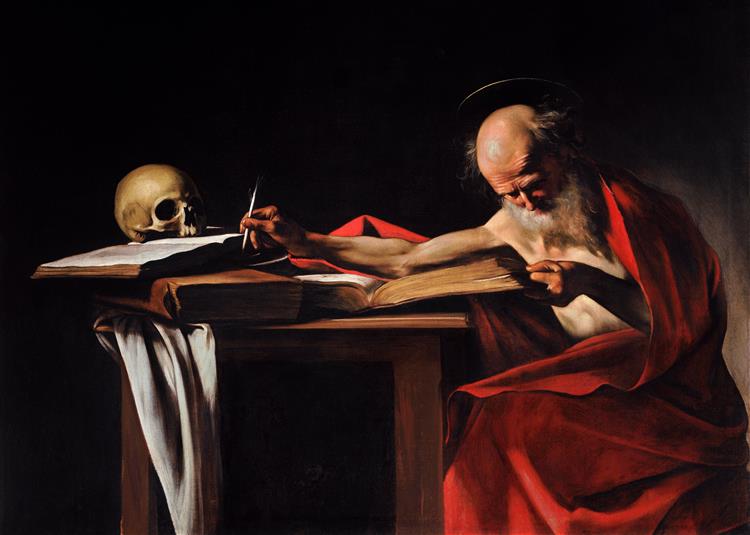
«Saint Jerome Writing», c. 1605-1606, by Caravaggio Oil on canvas 112 cm × 157 cm (44 in × 62 in)
According to Giovanni Pietro Bellori, the painting was made by the artist for Cardinal Scipione Borghese, a sophisticated and avid collector, known among his contemporaries for being one of the greatest admirers of the promising Lombard painter.
The painting depicts St. Jerome, a doctor of the Church, studying the Sacred Scriptures which, according to tradition, he translated from Greek to Latin. In fact, the saint is hailed for his qualities as a studious man, portrayed as an elderly humanist hunched over the complex exegesis of the sacred text.
The compositional partitioning into two large fields of colour, distinguished by warm tones – such as the skin of the saint and the purple mantle – and cold ones – the skull and white cloth standing out against the open book – seems to emphasise a symbolic dialogue between contrasting contents: life and death, past and present.
Because of some rapidly painted details and the straightforward way the paint was applied, some critics have hypothesised that the canvas was never completed.
The autorship of Saint Jerome Writing by Caravaggio is sometimes questioned, as it was attributed to Jusepe de Ribera in the Borghese inventories from 1700 until 1893.
The painting is located in the Galleria Borghese, in Rome.
There is another version of the painting, which Caravaggio painted around 1608 whilst in Malta. The second version of the painting was commissioned by Ippolito Malaspina, Prior of the Order of Malta in Naples.
Thus, in Western European art of the 17th and 18th centuries, the Caravaggist movement emerged, which to a certain extent stood in contrast to both the Baroque style that dominated the era and international Mannerism.
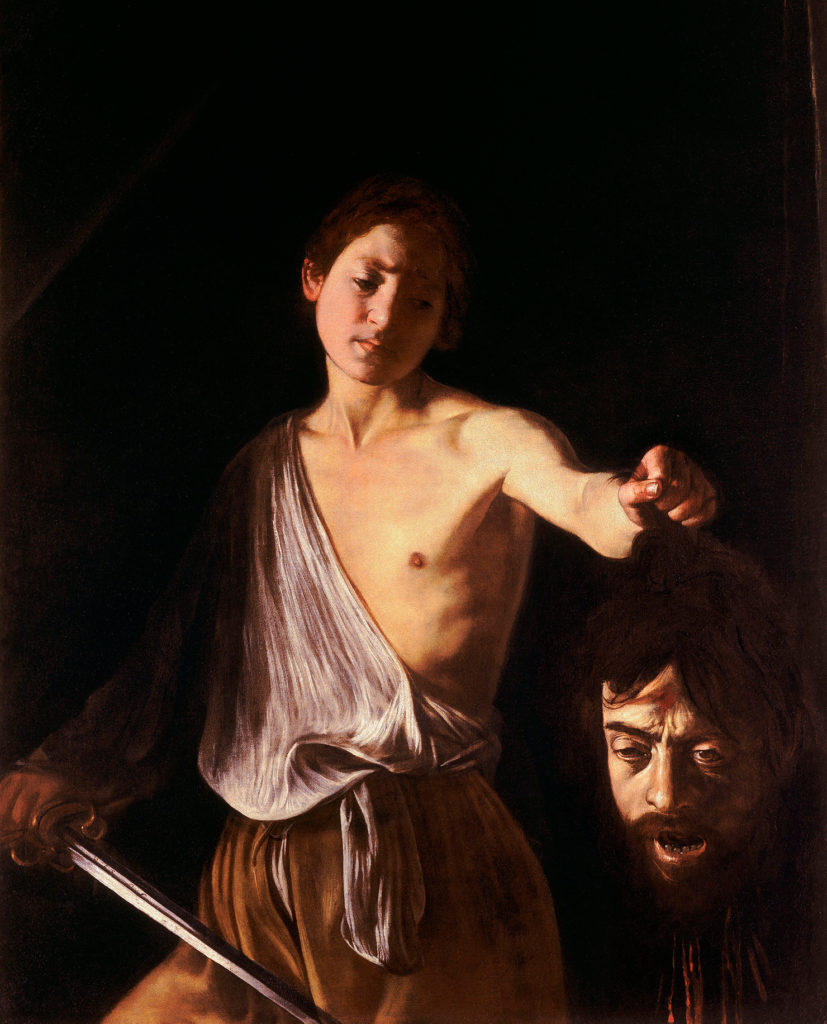
«David with the Head of Goliath» 1609–1610 by Caravaggio Oil on canvas 125 cm × 101 cm (49 in × 40 in)
Galleria Borghese, Rome
David is perturbed, «his expression mingling sadness and compassion». (Catherine Puglisi, Caravaggio (Phaidon, 1998) The decision to depict him as pensive and resigned rather than jubilant creates an unusual psychological bond between him and Goliath. This bond is further complicated by the fact that Caravaggio has depicted himself as Goliath, while the model for David is il suo Caravaggino («his own little Caravaggio»). This most plausibly refers to Cecco del Caravaggio, the artist’s studio assistant in Rome some years previously, recorded as the boy «who lay with him».
No independent portraits of Cecco are known, making the identification impossible to verify, but «[a] sexual intimacy between David/model and Goliath/painter seems an inescapable conclusion, however, given that Caravaggio made David’s sword appear to project upward, suggestively, between his legs and at an angle that echoes the diagonal linking of the protagonist’s gaze to his victim». (Catherine Puglisi, Caravaggio (Phaidon, 1998)
Alternatively, based on the portrait of Caravaggio done by Ottavio Leoni, this may be a double self-portrait. The young Caravaggio (his own little Caravaggio) wistfully holds the head of the adult Caravaggio. The wild and riotous behaviour of the young Caravaggio essentially had destroyed his life as a mature adult, and he reflects with a familiar hermeticism on his own condition in a painting of a related religious subject.
Paintings with scenes by candlelight by the painter-in-ordinary to the king Louis XIII
Georges de La Tour was an outstanding Baroque painter from Lorraine and the foremost exponent of Caravaggism in France. He is renowned for his unique works, which make masterful use of chiaroscuro, often depicting scenes by candlelight. Forgotten for two centuries, he was rediscovered in the 20th century, and his paintings were mistakenly attributed to Rembrandt and Murillo.
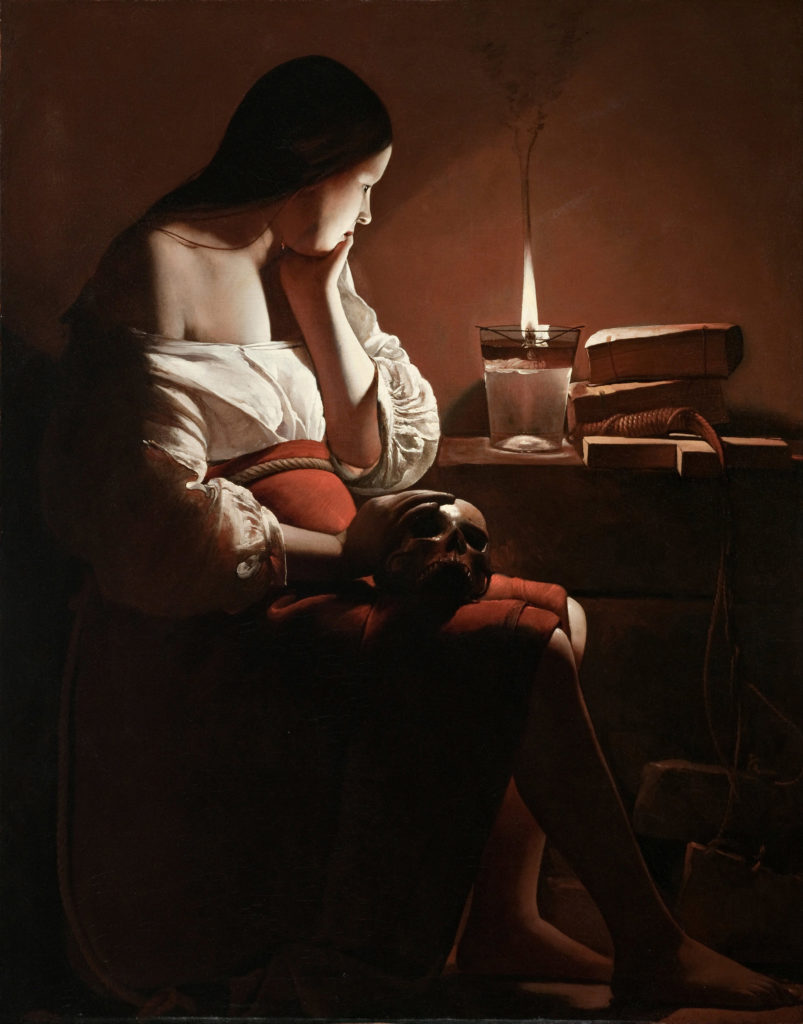
“Magdalene with the Smoking Flame” (also titled in French La Madeleine à la veilleuse, and La Madeleine à la flamme filante) is a c. 1640 oil-on-canvas 128 cm × 94 cm (50 in × 37 in) depiction of Mary Magdalene . Two versions of this painting exist, one in the Los Angeles County Museum of Art and the other in the Louvre Museum (La Madeleine a la veilleuse).
The Louvre version of the painting was bought in 1949 from the French Administration des Douanes. In the somewhat uncertain chronology of Georges de La Tour’s work, this painting has been allotted the date of 1640, by analogy with the Saint Mary with a Mirror, which has been dated between 1635 and 1645. The location of this painting before 1949 is unknown.
Georges de La Tour was a Catholic Baroque artist with a successful career, despite the fact that he was working at an unsettling time of religious wars and the violence that followed. He learned many skills from the work of Caravaggio such as tenebrism, an especially dramatic contrast between light and shadow.
He mainly painted religious works featuring original chiaroscuro effects by candlelight.
His artwork is known to be thoughtful, genuine and sincere.
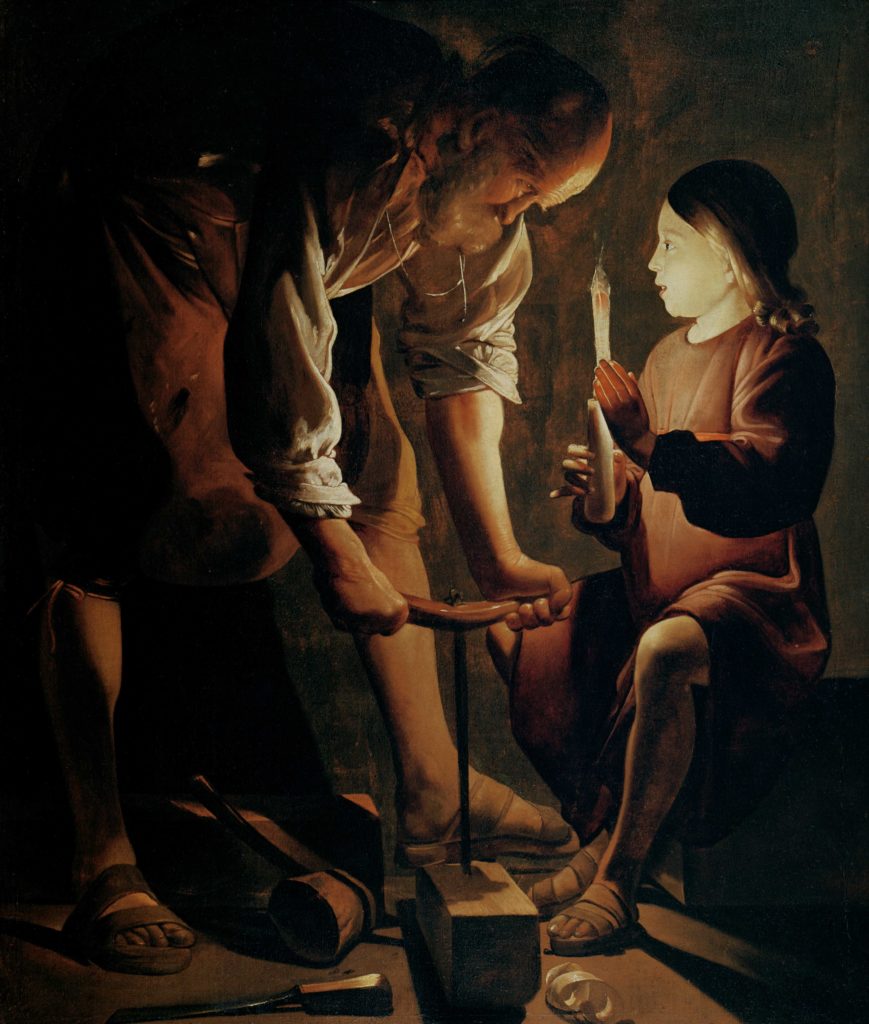
“Saint Joseph the Carpenter” (French: “Saint Joseph charpentier”) is a famous painting by the French artist Georges de La Tour, created around 1638–1645. This Baroque masterpiece is currently housed in the Louvre (Paris), striking the viewer with its realism, use of chiaroscuro and its intimate, cosy atmosphere.
The painting is executed in oil on a rather unusual, very dense canvas, and measures 137 × 102 cm.
The painting depicts a scene from Jesus’ childhood. His foster father, Joseph, is practising his craft as a carpenter, drilling a piece of wood with a special drill bit. The shape of the tool corresponds to that of the Cross, and the piece of wood lying on the floor is positioned in a cross-like formation relative to the figure of the seated Jesus, alluding to his impending crucifixion. Moreover, the boy, sitting patiently beside his father and holding a candle to light his work, demonstrates both “filial obedience and acceptance of his own fate as a martyr”.
In this case, the candle serves as the sole, powerful and central source of light, surrounded by shadows.
The artist emphasises the divine nature of the infant Jesus by depicting him with his hand raised, as if in blessing. At the same time, the light of the candle, shining through the flesh, serves as an allegorical reference to Christ as the “Light of the World”.
It is precisely this detail that indicates that what we are looking at is not merely a genre scene, but a depiction of divine light—not illuminating the carpenter, but emanating from his God-given Son.
Rembrandt and Inner Radiance
The work of the Dutch master Rembrandt is inextricably linked to the spirit of the Dutch Golden Age – an era characterised by economic prosperity, intellectual flourishing and unprecedented artistic innovation. In his artworks, whether portraits of his fellow citizens or dramatic biblical scenes, he captured the essence of this era. His paintings resonate with a wide and varied audience, being not only masterpieces of painting but also a universal exploration of human emotions. He did not merely capture the world around him – he interpreted it through the prism of his own experience and understanding. Rembrandt’s influence on subsequent generations of artists is immeasurable, inspiring countless painters, engravers and draughtsmen to explore the power of light and shadow beyond the confines of any particular artistic style.
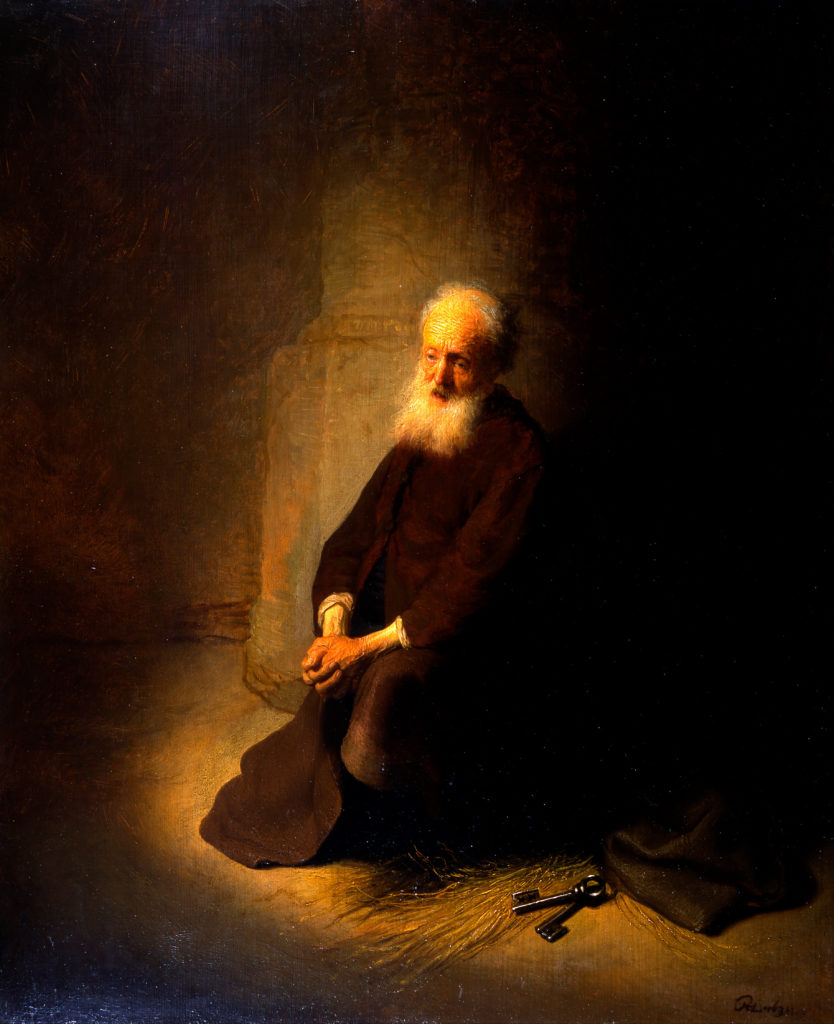
“Saint Peter in Prison” (1631) by Rembrandt van Rijn, oil on panel — an early painting by Rembrandt depicting the apostle in prison, executed in the chiaroscuro style. The work, measuring 59.1 × 47.8 cm, is located in the Israel Museum in Jerusalem.
The painting focuses on the deep emotional experiences of the figure, lost in thought in the dim light.
Saint Peter, imprisoned in a dark cell, is shown in a moment of deep reflection or on the verge of a miraculous release.
The painting is executed in the style of the play of light and shadow characteristic of Rembrandt’s early period, where soft light draws the figure out of the darkness and highlights Rembrandt’s ability to convey the psychological depth and drama of biblical scenes.
Whilst Caravaggio focused on dramatic external lighting, the Dutch master Rembrandt took a more subtle, psychological approach. His paintings often appear bathed in a warm, soft light that seems to emanate from within the figures themselves.
In portraits such as “The Jewish Bride” or “Self-Portrait with Two Circles”, the light helps to reveal not only the appearance but also the character of the people depicted.
This approach turned portraiture into a true window into the human soul. Light ceased to merely outline forms and convey external dynamics and movement – it came to express emotions, inner states and contradictions.
Rembrandt was a pioneer of light. He used self-portraits to demonstrate the power of light. He used light to reveal texture, depth and emotion. His technique, known as Rembrandt lighting, employs a triangle of light on the cheek to create a profound narrative.
He uses a single light source to create a distinctive triangle of light on the subject’s face.
A small triangle of light falls on the cheek beneath the eye on the side of the face opposite the main light source. This pattern of light is ideal for people with any face shape, adding depth and enhancing the contours. With this lighting, one half of the subject’s face will be fully lit, whilst the other remains partially in shadow.
Rembrandt’s lighting is characterised by simplicity and drama. It gives people’s faces a new look. The light triangle adds depth and emotion to the subject’s face, allowing it to stand out.
At that time, artists worked in limited lighting, using candles or oil lamps. Rembrandt changed everything with his unique approach to light, influencing even modern photography and cinema.
In film and theatre, this technique is used to convey the drama of a scene. In photography, it adds depth, highlights facial features and evokes emotion.
A key feature of this style is the ‘Rembrandt triangle’. This is a patch of light the width of the eyes and the length of the nose. This technique adds depth and emotion to portraits, enhancing the three-dimensional appearance of the subject’s face. The contrast between light and shadow creates a natural yet dramatic effect, drawing attention to the subject’s features.
This technique creates a sense of intensity or mystery. The placement of the light helps to emphasise the contours of the face, which are often used in portraits to convey emotions such as determination or introspection. Rembrandt lighting transforms simple portraits into dramatic stories.
The key elements underlying Rembrandt lighting are:
The famous Triangle of Light – the heart of Rembrandt lighting. It creates a small triangular highlight on the subject’s cheek. To set this up, position the key light at a 45-degree angle to the subject, slightly above the eyes.
Understanding the ratio of light to shadow. This ratio is 3:1 or 4:1, making the lit side of the face much brighter than the shadowed side, adding depth to portraits.
The chiaroscuro effect, which creates a sharp contrast between light and shadow. This technique emphasises facial features, drawing the viewer’s gaze. It is a powerful way to tell stories through images.
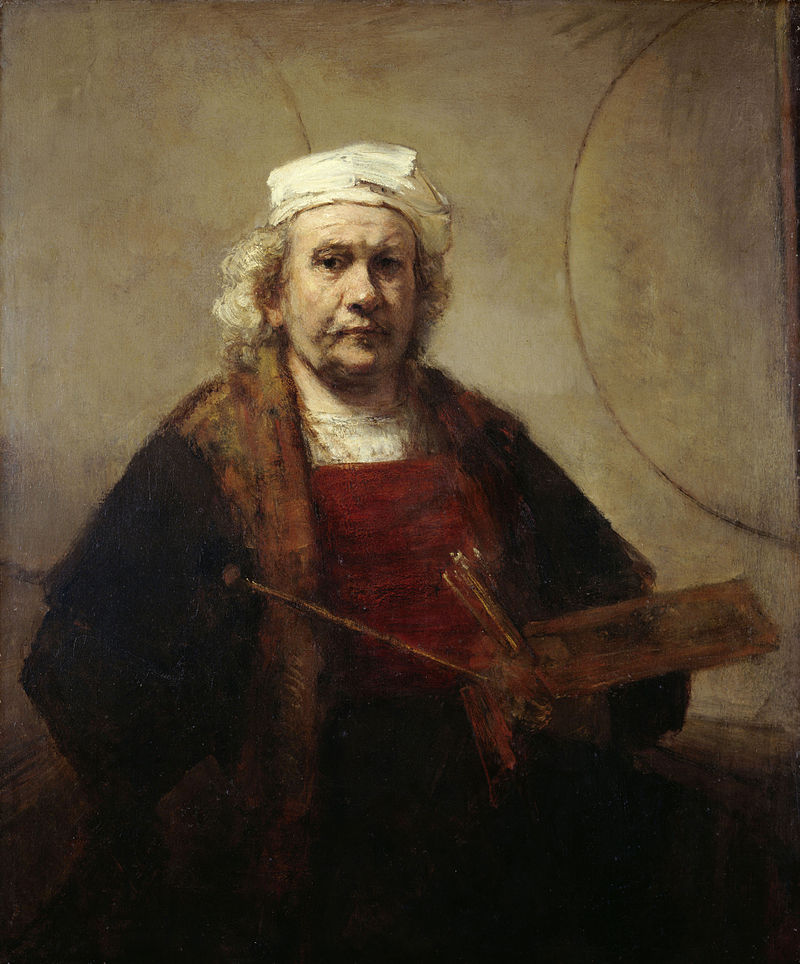
«Self-Portrait with Two Circles» is one of Rembrandt’s most enigmatic and monumental works, created between 1665 and 1669. In the painting, the artist depicts himself full-length with a palette, brushes and an easel against a wall featuring two drawn circles.
Date: c. 1665–1669 (late period).
Location: Kenwood House, London.
Technique: Oil on canvas.
Dimensions: Approx. 114 × 94 cm (dimensions vary across sources).
«Self-Portrait with Two Circles» is one of more than 40 self-portraits painted by Rembrandt (as well as roughly the same number created using other media), and one of many images produced in various media, dating back to at least 1629, in which he is depicted at work: drawing, engraving or painting.
The painting stands out among the artist’s other self-portraits for its unusual composition and symbolism. The main mystery of the canvas is the two circles in the background. There are several theories as to their meaning. Some researchers suggest that the circles are a symbol of mastery. Referring to the legend of the artist Giotto, who could draw a perfect circle in a single stroke without a compass, Rembrandt demonstrates his professionalism. Others see in them a geographical symbol of the Earth’s two hemispheres, whilst others interpret them as mathematical harmony or infinity.
The painting is executed in the impasto technique—using thick, textured brushstrokes—which creates a distinctive texture and play of light characteristic of the master’s late style.
The work is considered a ‘defining’ piece in which Rembrandt asserts his worth as an artist, despite financial difficulties and obscurity towards the end of his life.
As in many of the artist’s later works, the painting is characterised by an improvisational style of execution, and certain details appear unfinished.
In his later period (the 1650s–1669), Rembrandt’s technique became incredibly bold and free. He ceased to strive for the smoothness characteristic of his contemporaries and began literally to ‘sculpt’ form with paint.
His style at that time was characterised by extreme impasto (thick application of paint). Rembrandt applied the paint in such thick layers that it became three-dimensional. In ‘The Jewish Bride’, the sleeves of the dress look like a real relief. He used not only brushes but also a palette knife (a spatula), and sometimes applied paint with his fingers or the handle of a brush.
When light falls on these irregularities, it creates an additional play of shadows directly on the surface of the canvas, bringing the clothing to life.
Furthermore, despite his rough brushstrokes, Rembrandt masterfully employed a complex glazing technique—applying thin, transparent layers of paint over dried, thick layers. This allowed him to achieve incredible depth of colour (particularly in reds and golds). As light passes through the transparent layers, it reflects off the underlying ground and creates an effect of inner glow.
Towards the end of his life, the artist moved away from bright, vivid colours. His palette became almost monochromatic, based on just a few colours: ochre and golden-brown tones, deep red (vermilion, carmine), black and white.
This minimalism helped the viewer to focus on the characters’ emotions rather than on the details of everyday life.
In contrast to his early works, which featured stark theatrical lighting (Caravaggism), in his later paintings the light appears diffused and seems to emanate from the figures themselves. Faces and hands stand out against the deep darkness, creating an atmosphere of intimacy and spirituality.
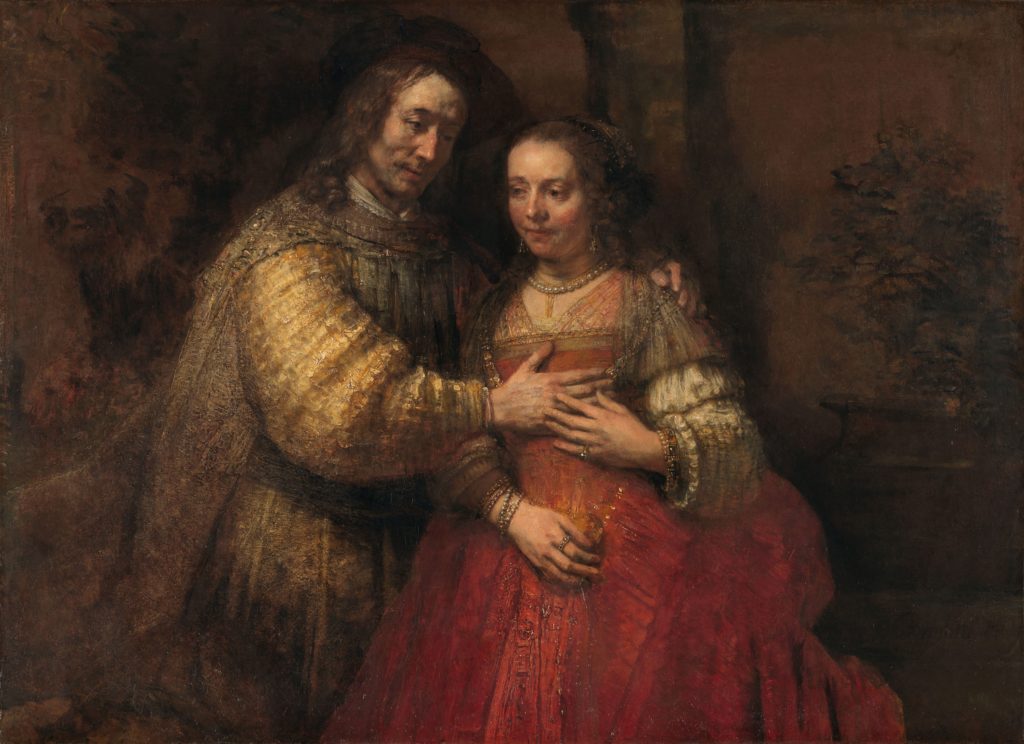
“The Jewish Bride” (Dutch: “Het Joodse Bruidje”) is one of Rembrandt’s last and most enigmatic paintings, created around 1665–1669. The canvas depicts a couple in an intimate, tender pose, dressed in rich, fanciful garments reminiscent of biblical times. The painting was not given its title until 1825, and the true identities of the figures remain unknown, giving rise to a multitude of interpretations.
Location: Permanent exhibition at the Rijksmuseum in Amsterdam.
The title ‘The Jewish Bride’ was given to the painting by the collector Van der Hoop, who mistakenly interpreted the scene as a father presenting a necklace to his daughter. It is believed to depict a biblical couple, most commonly identified as Isaac and Rebecca, as a drawing by Rembrandt from 1662 with a similar composition has survived.
The painting is known for its thick impasto, warm golden light and deep emotionality, and is characterised by a soft, diffused light emanating from the figures themselves, filling the painting with an atmosphere of intimacy and a special spirituality.
Rembrandt was one of the first to realise that a painting is not finished when every button has been painted, but when the artist has achieved his aim in it. His brushstrokes in the background may appear to be chaotic strokes, but from a distance they come together to form a perfect shape.
Rembrandt became an artist who shaped the direction of painting for several centuries. And his approach to lighting and the rendering of light became the foundation for many artistic movements.
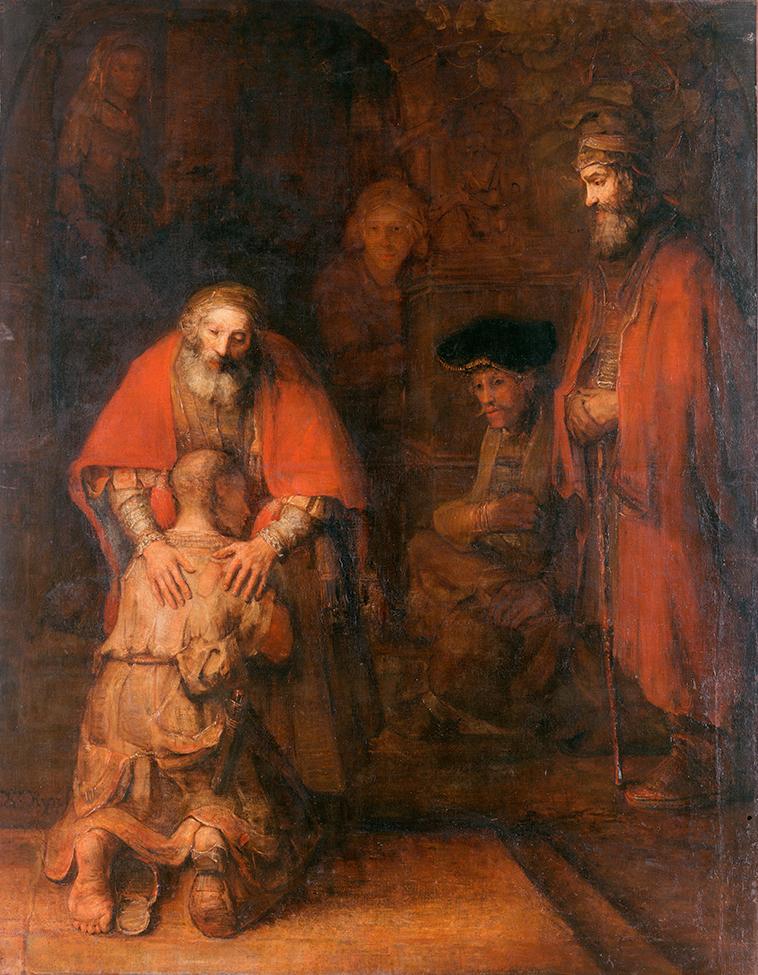
The Return of the Prodigal Son (Rembrandt)
c. 1666–1669, oil on canvas, 260 × 203 cm, The Hermitage, Saint Petersburg, Russia
The art historian Horst Janson writes that The Prodigal Son is ‘perhaps Rembrandt’s most moving painting. It is also his quietest painting—a moment fading into eternity. The atmosphere of gentle stillness is so pervasive that the viewer feels a kinship with this group. This connection is perhaps stronger and closer in this painting than in any of Rembrandt’s earlier works.”
The circumstances surrounding the painting’s creation remain a mystery. It is believed to have been painted during the final years of the artist’s life.
This painting is a classic example of composition in which the main subject is significantly offset from the central axis of the picture in order to convey the work’s central idea as effectively as possible.
‘Rembrandt highlights the focal point of the painting with light, drawing our attention to it. The compositional centre lies almost at the edge of the painting. The artist balances the composition with the figure of the elder son standing on the right. Placing the main focal point at one-third of the height corresponds to the golden ratio, which artists have used since ancient times to achieve the greatest expressiveness in their works.
The artist placed the main figures at the junction of the pictorial and real spaces (the canvas was later extended at the bottom, but the artist’s original intention was for its lower edge to be level with the toes of the kneeling son).
«The depth of space is conveyed by a gradual weakening of chiaroscuro and color contrasts, beginning from the foreground. In fact, it is built by the figures of the witnesses to the scene of forgiveness, gradually dissolving into the semi-darkness.
The blind father places his hands on his son’s shoulders as a sign of forgiveness. This gesture contains all the wisdom of life, the pain and longing for years lived in anxiety, and the promise of forgiveness. Rembrandt highlights the main elements of the painting with light, focusing our attention on them. The compositional center is located almost at the edge of the painting. The artist balances the composition with the figure of the eldest son, standing to the right. The placement of the main focal point at one-third of the height corresponds to the golden ratio, which artists have used since ancient times to achieve maximum expressiveness in their works». (Basics of composition)
The painting has another detail that not everyone notices: the father’s hands are different. One is a man’s hand, the other a woman’s. Journalist Polina Zhukova, a member of the Union of Orthodox Journalists, offers a fascinating answer to the question: ‘Why does God have different hands in Rembrandt’s painting?’
The painting makes a very strong impression on the viewer. And Rembrandt’s genius continues to inspire artists to create new works.
1) Chiaroscuro (Italian for ‘light and shadow’) is an artistic technique based on the sharp contrast between light and shadow, used to lend an image volume, drama and depth. It highlights key elements, creating a theatrical effect where brightly lit objects stand out against a deep, dark background.
2) Tenebrism (Italian: Il tenebrismo, from the Italian tenebroso — gloomy, dark) — a painting style, technique and movement in Baroque art that emerged in Rome in the 17th century under the influence of Caravaggio’s paintings. The art of the tenebrists, like that of the ‘night scene painters’, is based on the use of light and shadow effects.
To be continued…