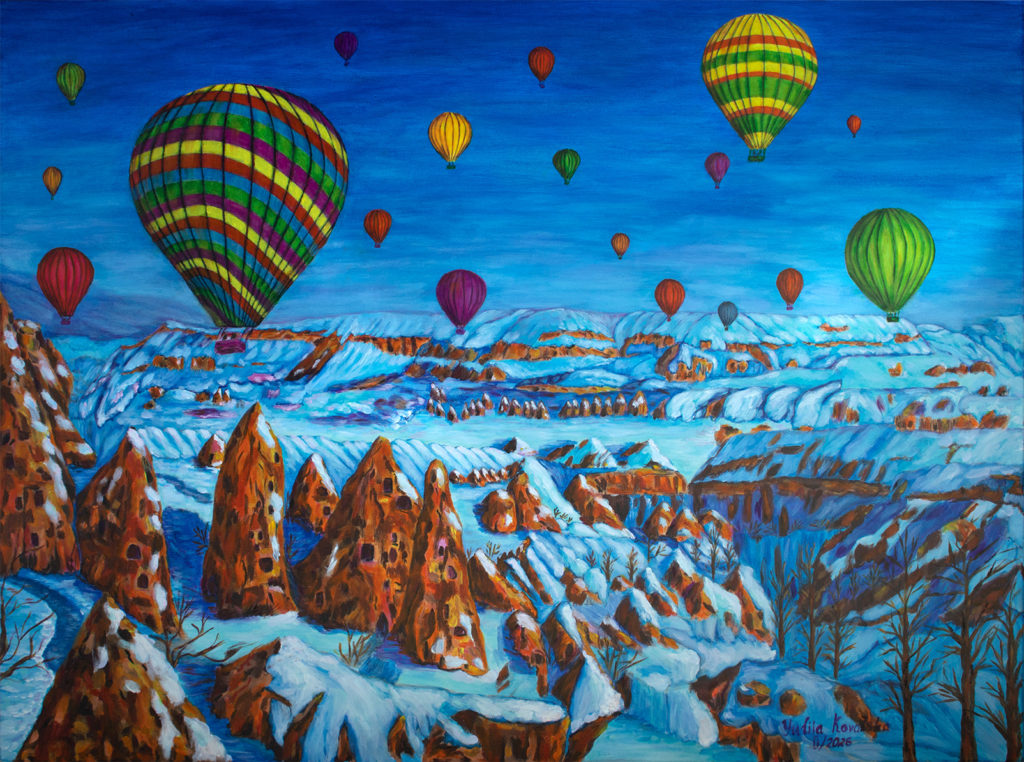
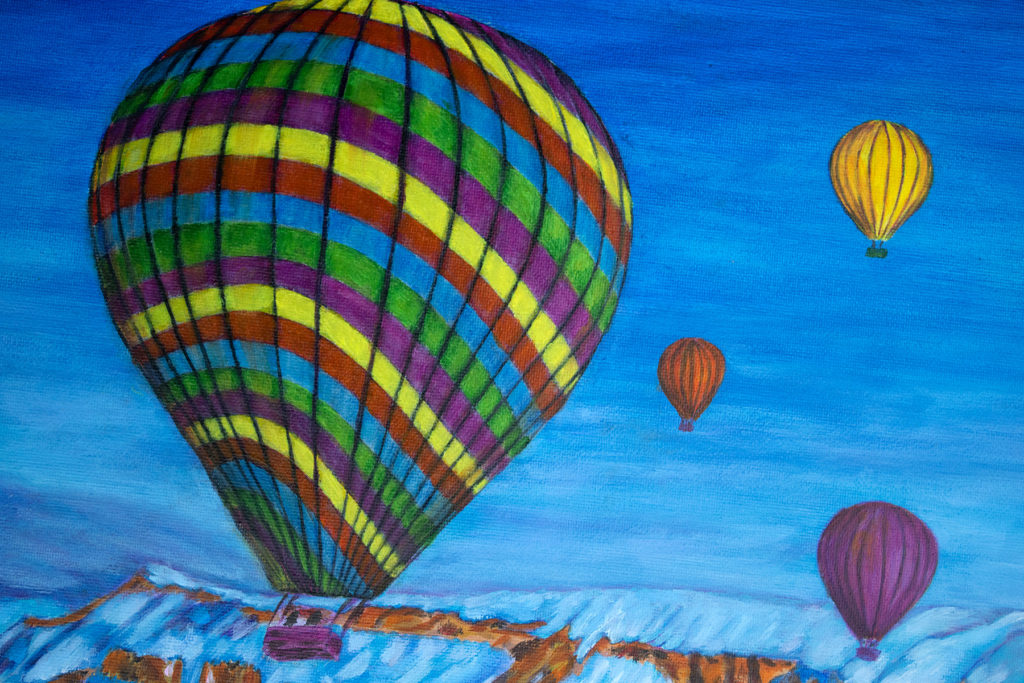
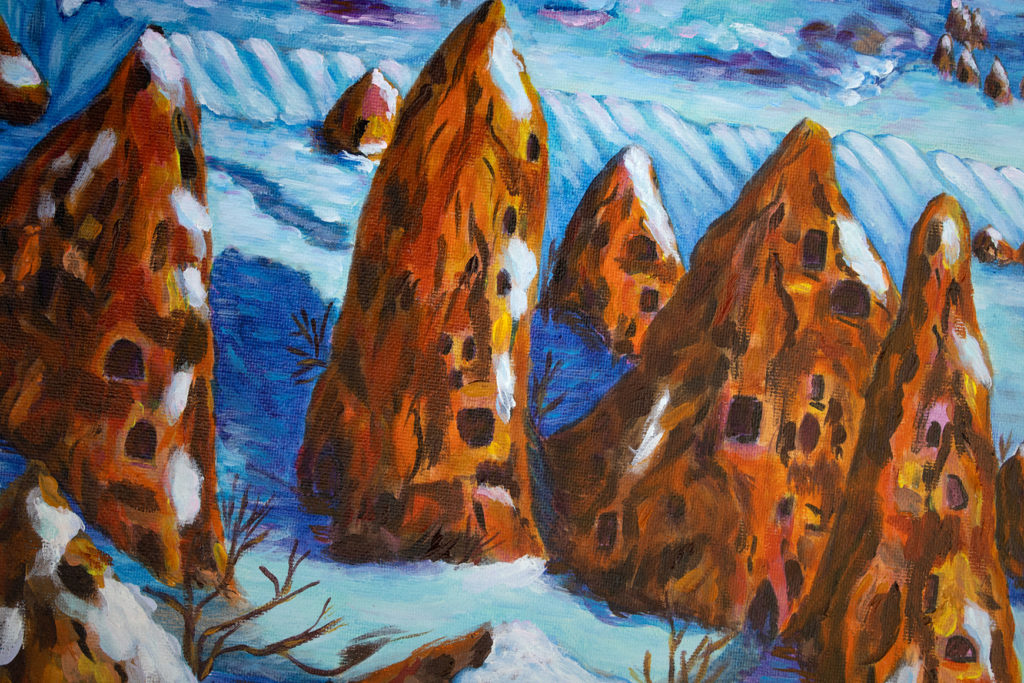
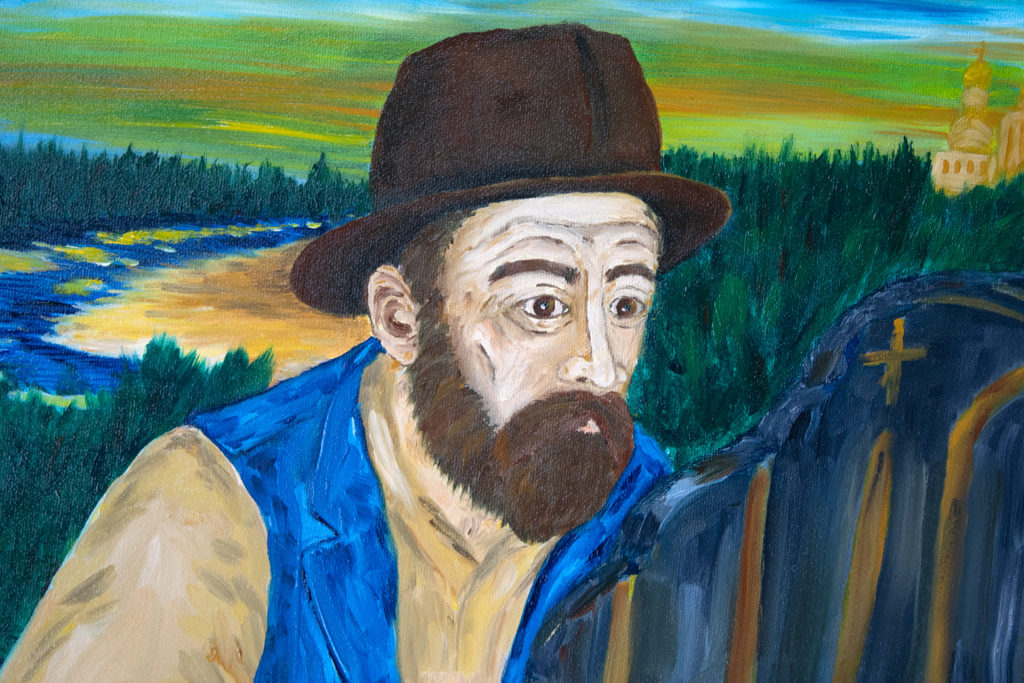
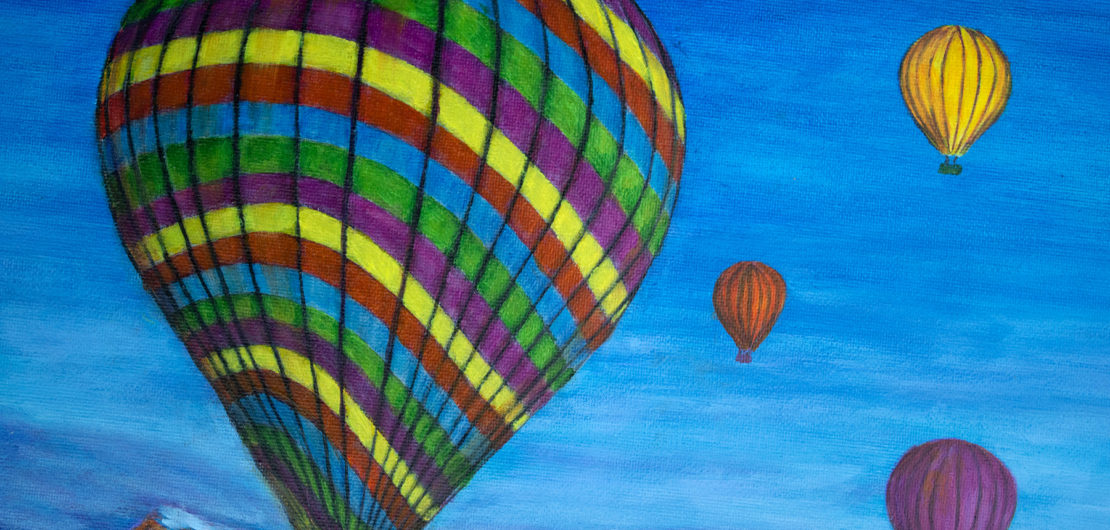
In this painting, I have sought to capture the mesmerising beauty of Cappadocia in winter, blending my own sense of wonder with the grandeur and solemnity of the natural formations. Hot-air balloons floating above the fairy-tale ‘magical chimneys’ create a sense of lightness and freedom, contrasting with the rugged, stony magnificence of the landscape. Feelings of tranquillity and, at the same time, admiration for this ancient land and its heavenly backdrop, revealed from a bird’s-eye view, awaken an interest in the history and mysteries of this wonderful region. Cappadocia is a unique historical region in Turkey, known for its ‘alien’ volcanic landscapes, ancient underground cities and rock houses where early Christians lived, as well as hot air balloon flights. It is a world-famous tourist destination, offering visitors cave hotels, rock monasteries, and the famous ‘fairy chimneys.’ And, of course, hot air balloon flights at dawn. Cappadocia is included in the UNESCO World Heritage List.
Cappadocia. Winter landscape
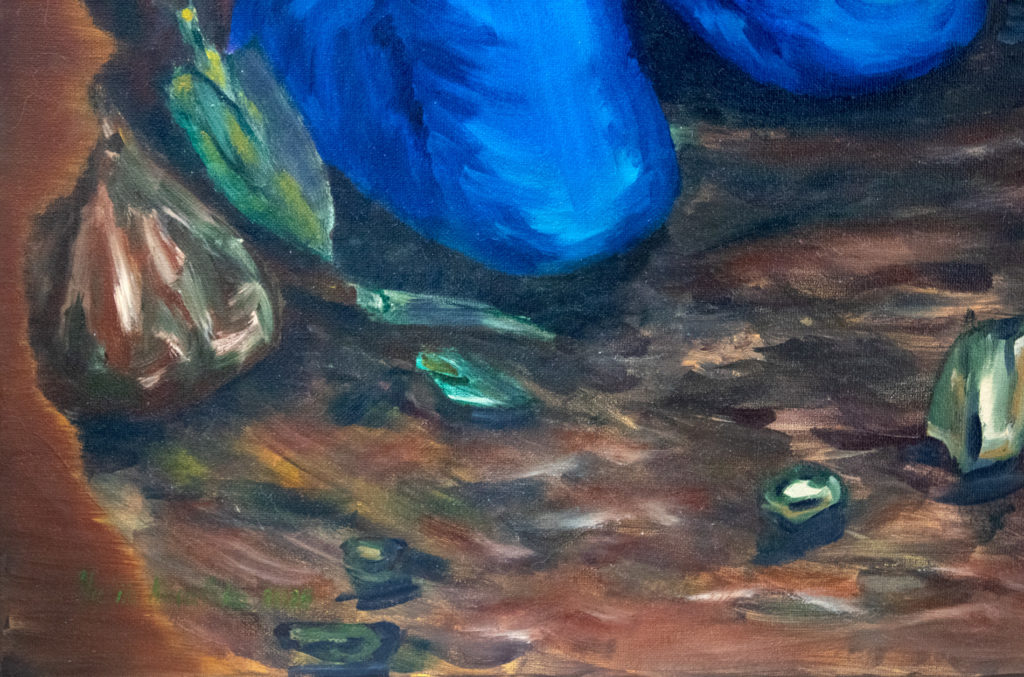
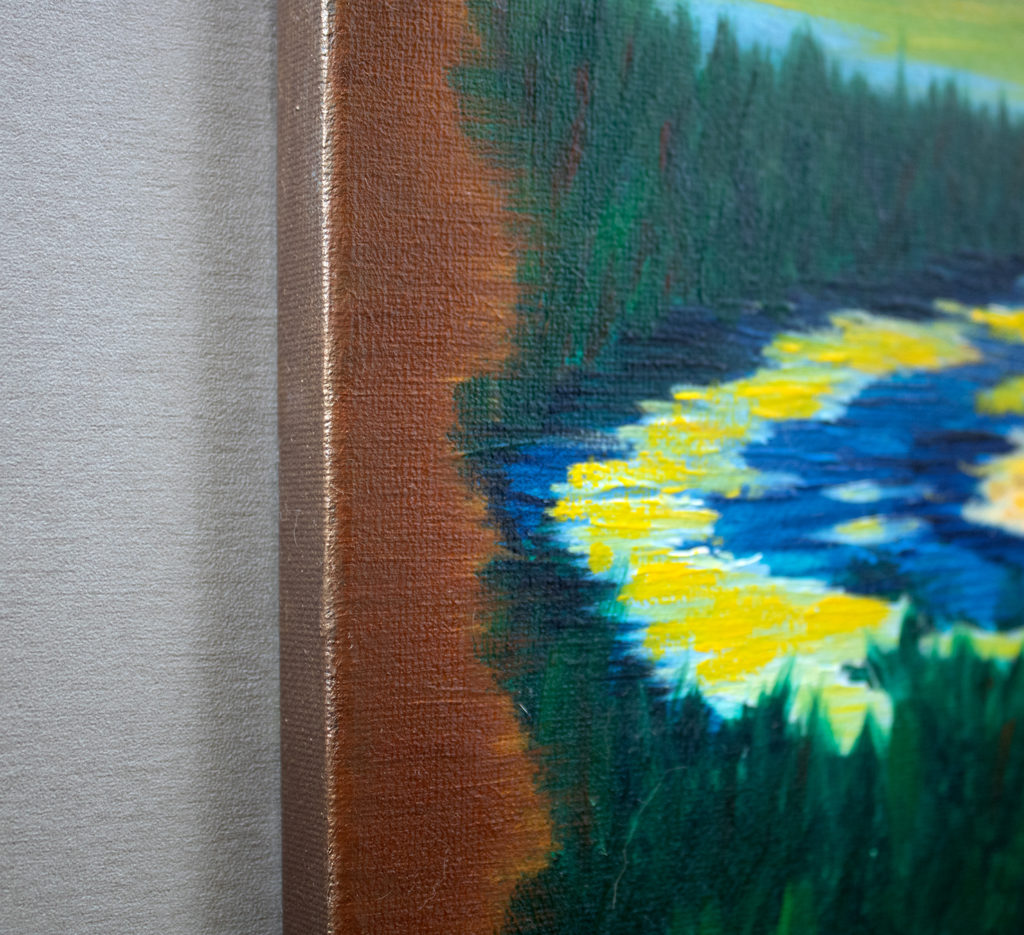
Cappadocia. Winter landscape. Close-up
Cappadocia. Winter landscape. Close-up
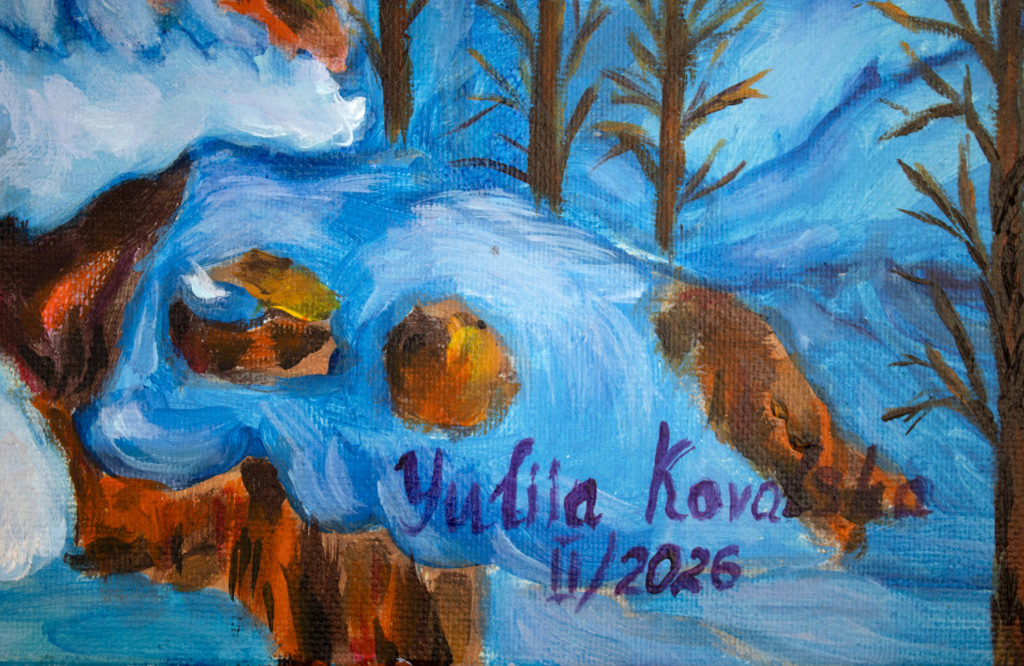
Cappadocia. Winter landscape. Close-up. Signature of the artist
The painting is a participant in the All-Ukrainian exhibition ‘Colours of the Peace’ in March 2026
If you are interested in this painting and would like to purchase it, please fill out and send the feedback form on the home page. You can also purchase this painting at the online galleries linked on the home page. Dispatch from Kiev (Ukraine)
TITLE: Cappadocia. Winter landscape YEAR: 2026 ARTWORK TYPE: Original Art/One of a kind DIMENSIONS: 80х60cm TECHNIQUES: Oil on acrylic undercoat RELATED THEMES: Landscape SUPPORT OR SURFACE: Canvas on the canvas-stretcher FRAMING: No CATALOGUE N: Kovalska148
If you are interested in this painting and would like to purchase it, please fill out and send the feedback form on the home page. You can also purchase this painting at the online galleries linked on the home page. Dispatch from Kiev (Ukraine)
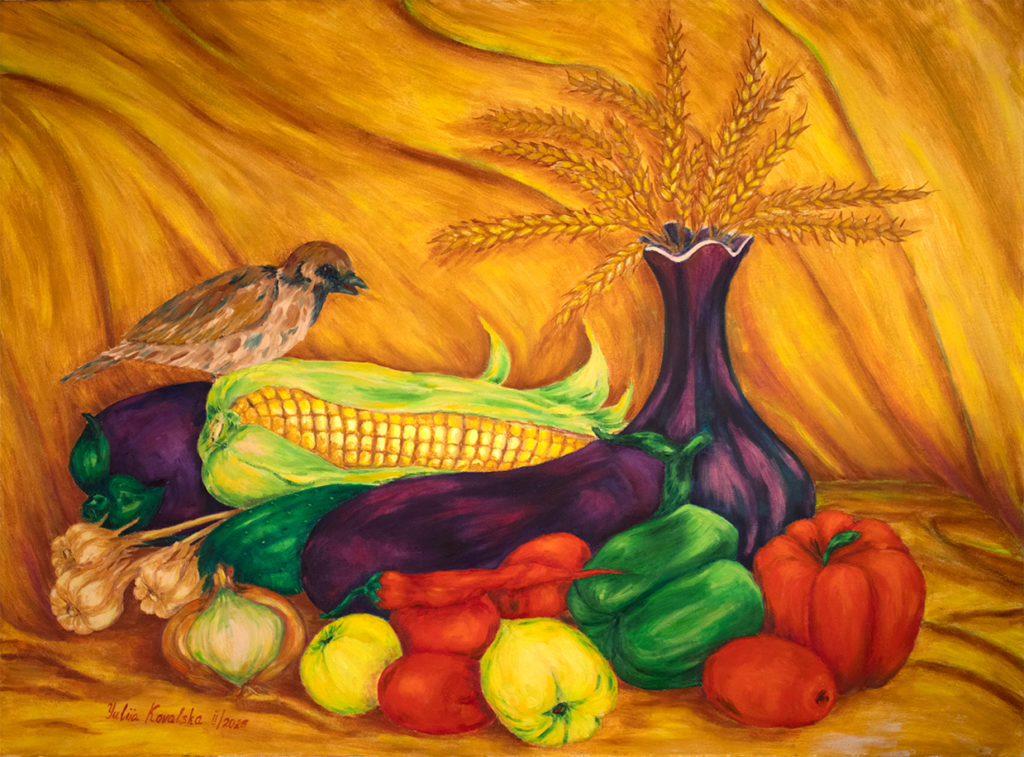
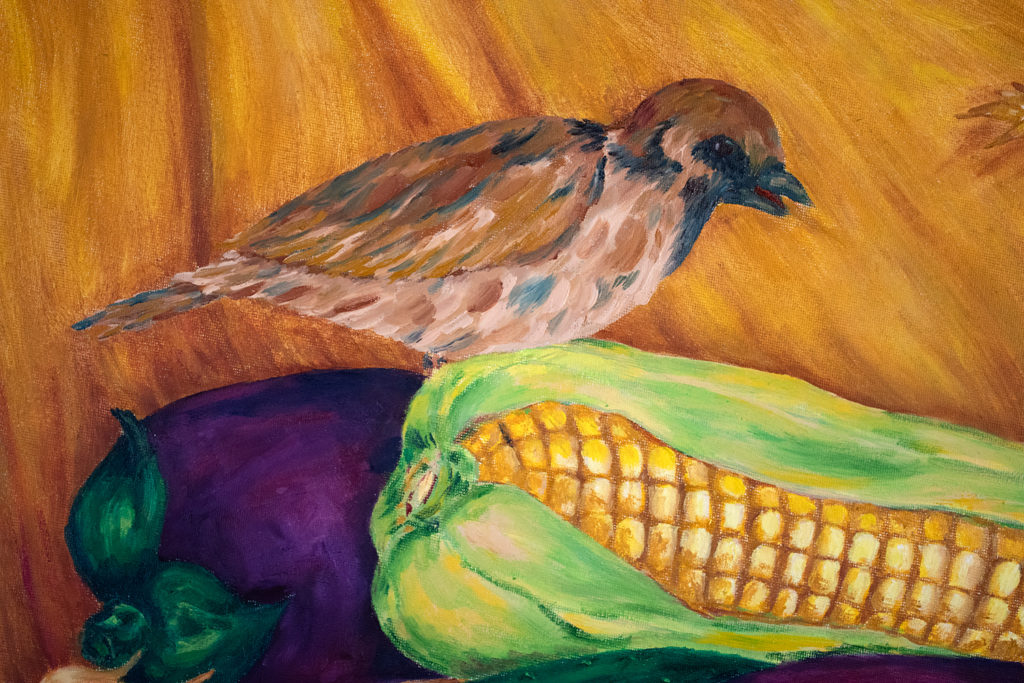
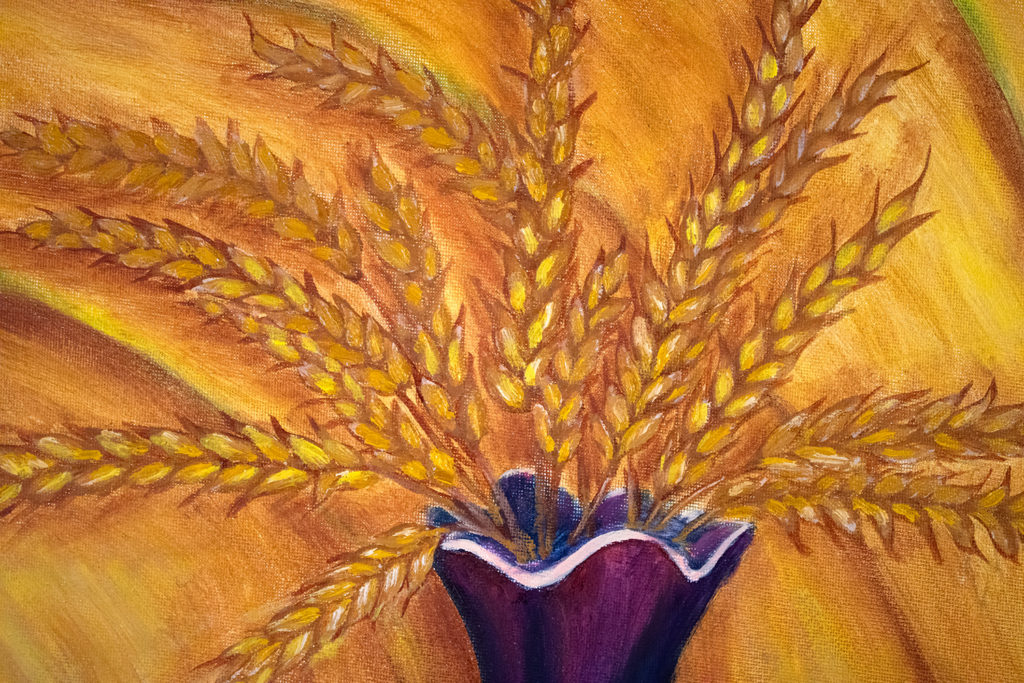
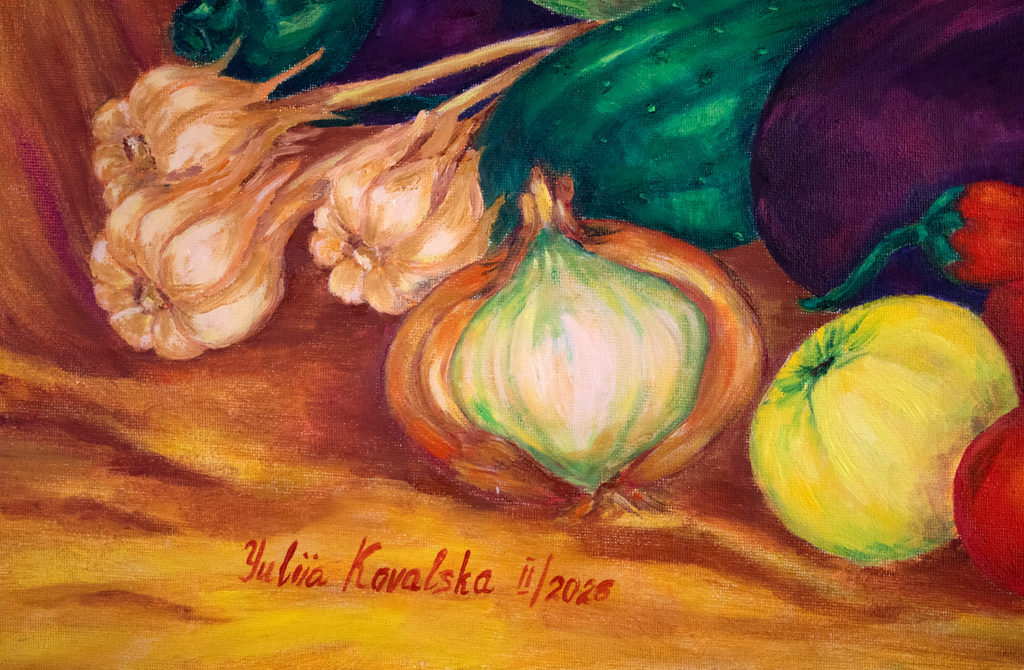
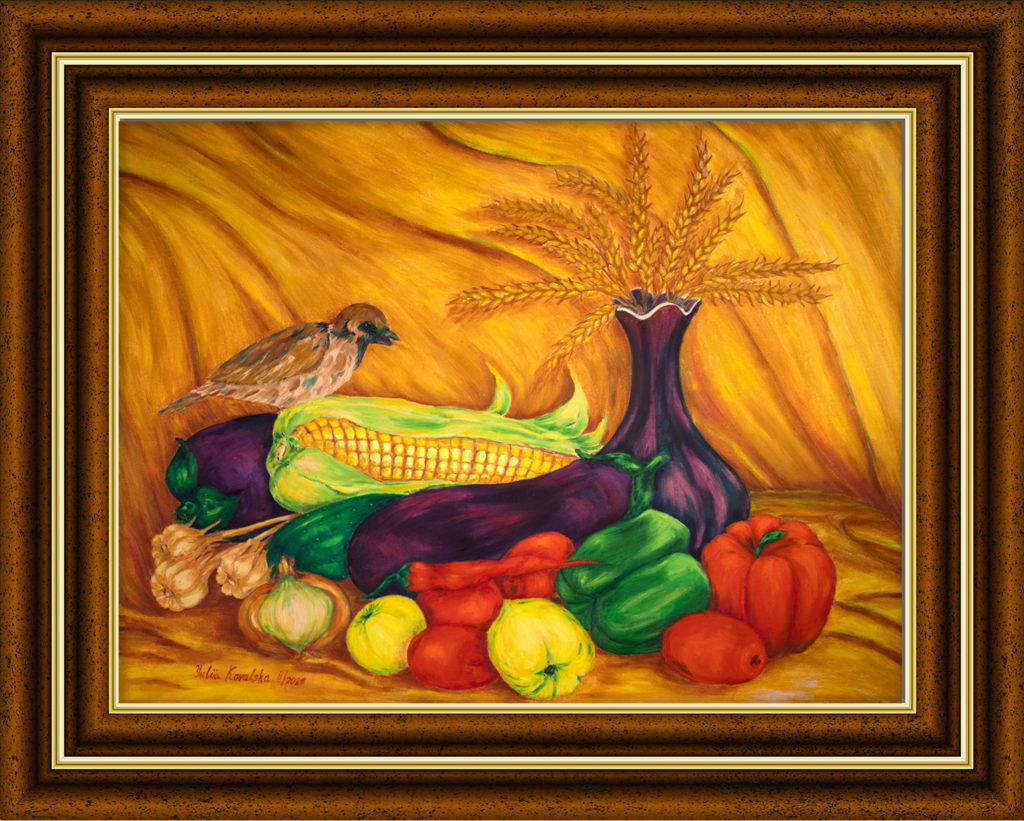
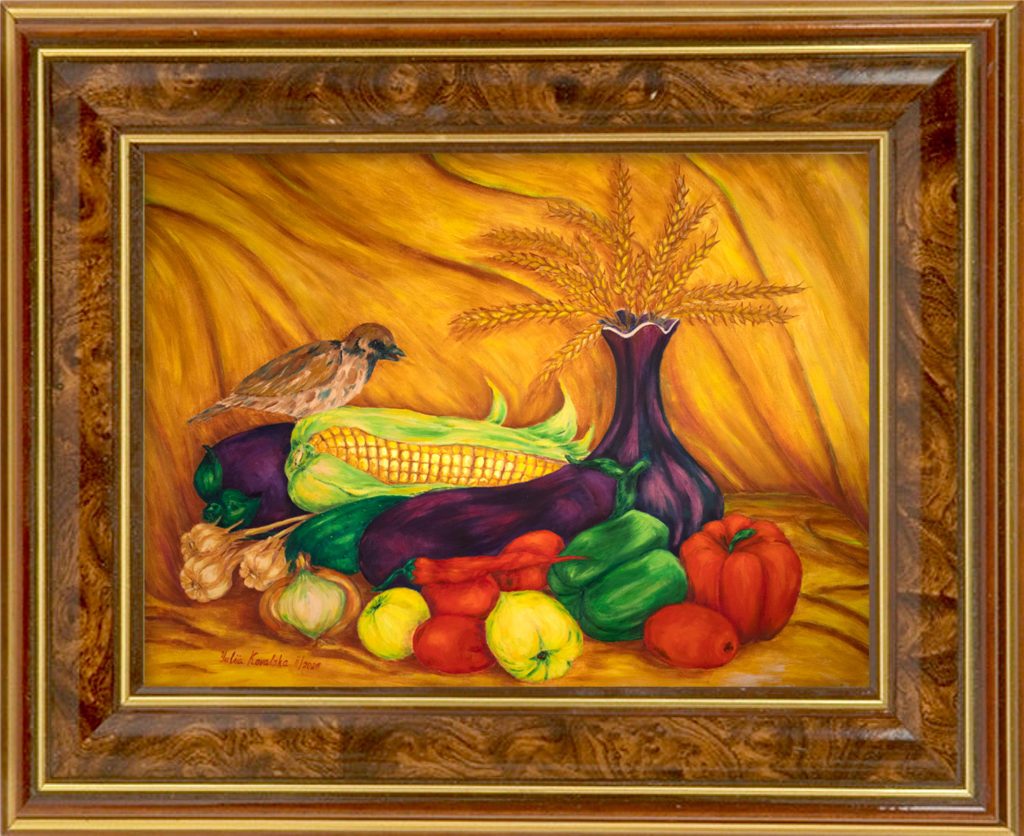
TITLE: Little sparrow YEAR: 2026 ARTWORK TYPE: Original Art/One of a kind DIMENSIONS: 80х60cm TECHNIQUES: Oil RELATED THEMES: Still life, birds SUPPORT OR SURFACE: Canvas on the canvas-stretcher FRAMING: No CATALOGUE N: Kovalska151
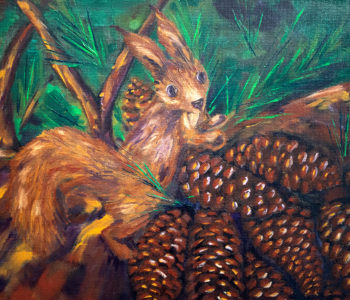
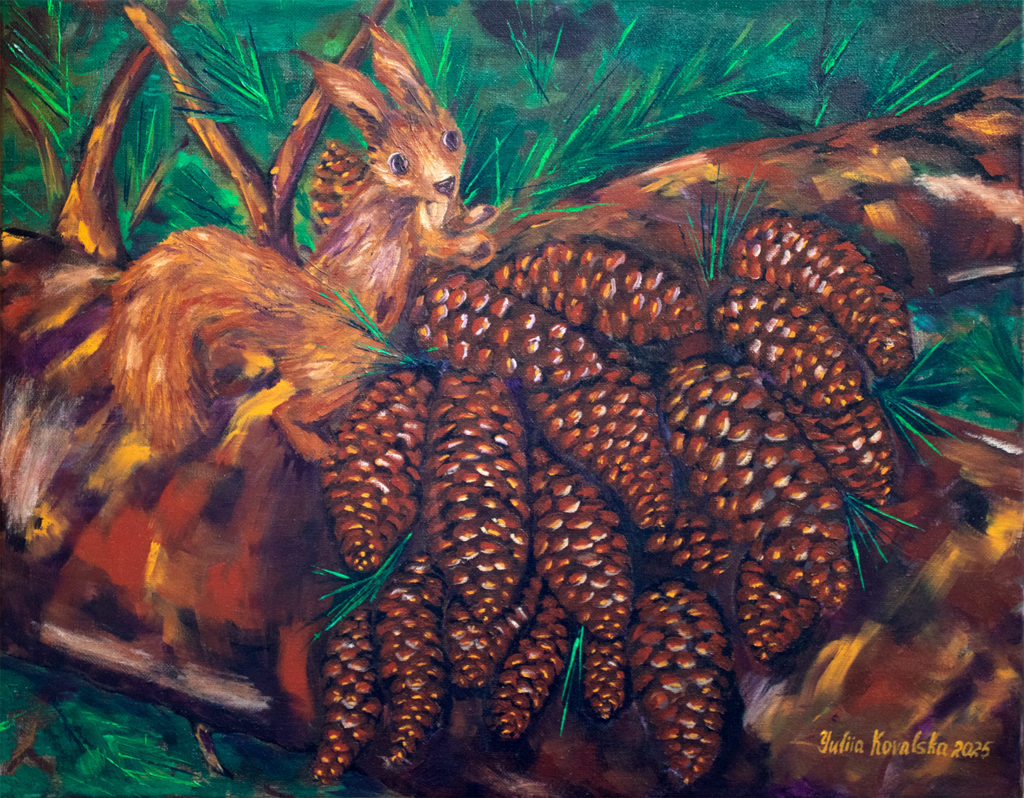
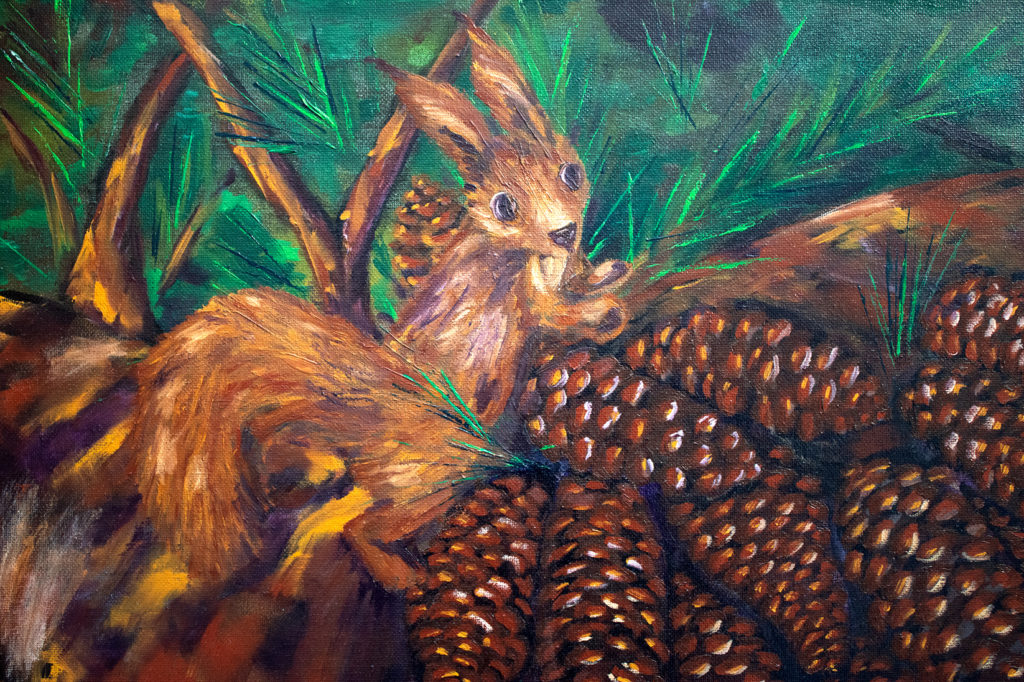
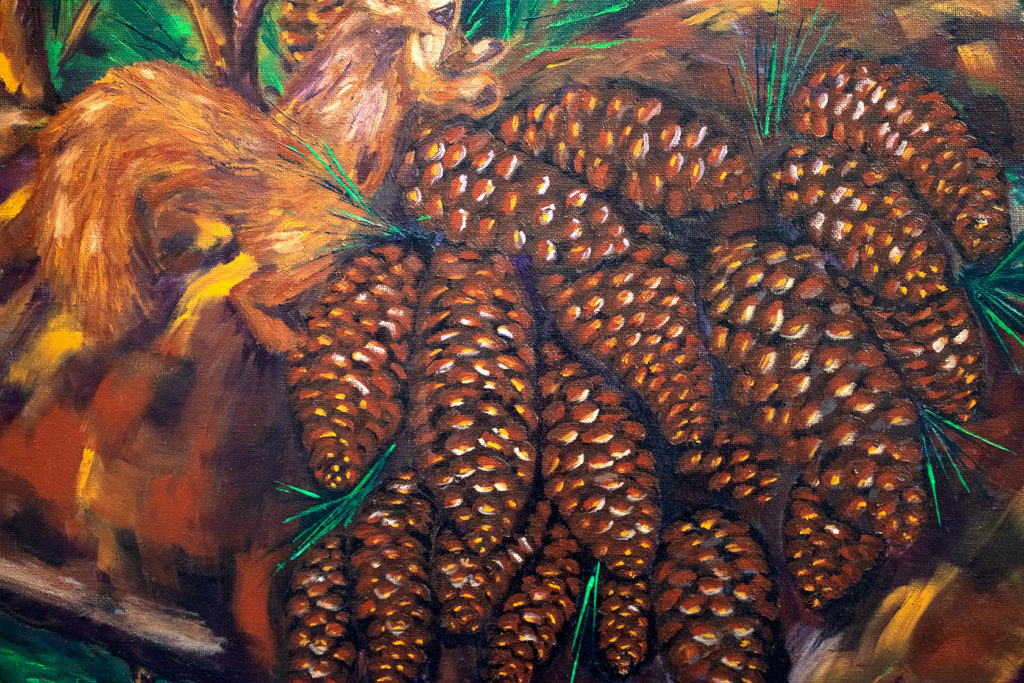
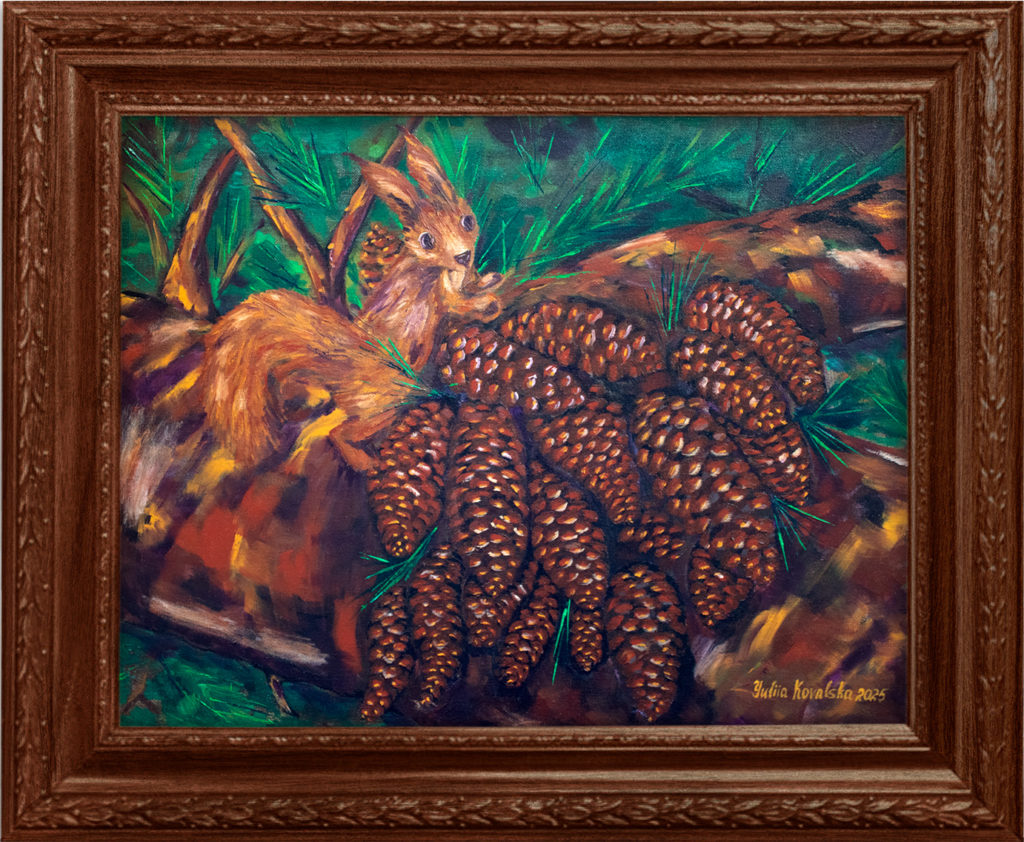
Tis a wonder well worth telling– Somewhere, there’s a squirrel dwelling In a fir tree; all day long, Cracking nuts, it sings a song.
Somewhere, there’s a squirrel dwelling…
Somewhere, there’s a squirrel dwelling… Close-up
Somewhere, there’s a squirrel dwelling… Close-up
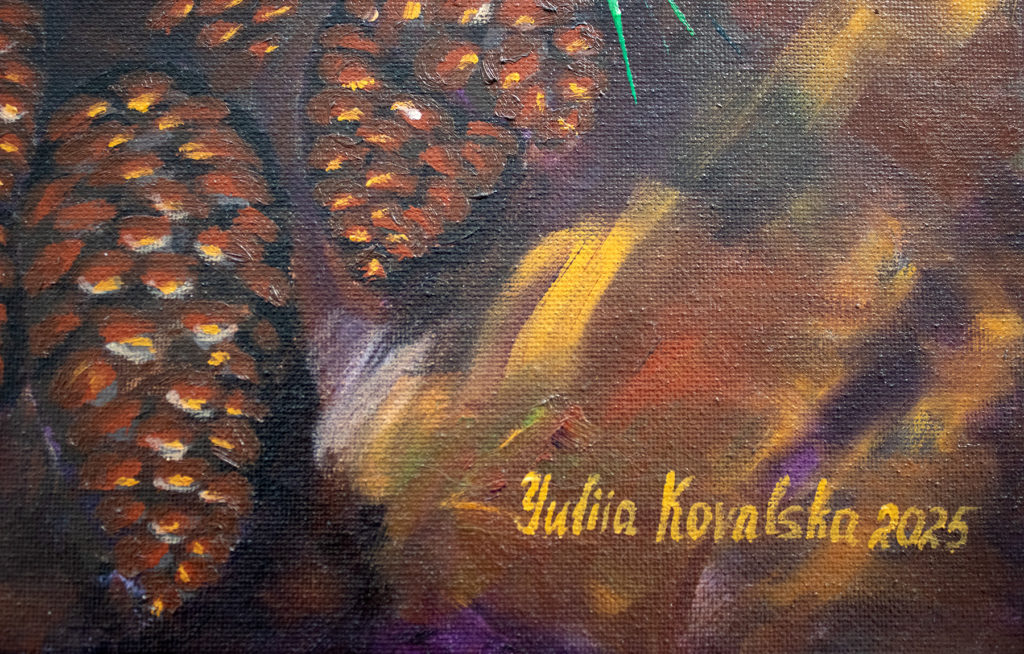
Somewhere, there’s a squirrel dwelling… Close-up. Signature of the artist
Somewhere, there’s a squirrel dwelling… Frame option
If you are interested in this painting and would like to purchase it, please fill out and send the feedback form on the home page. You can also purchase this painting at the online galleries linked on the home page. Dispatch from Kiev (Ukraine)
TITLE: Somewhere, there’s a squirrel dwelling… YEAR: 2025 ARTWORK TYPE: Original Art/One of a kind DIMENSIONS: 40х50cm TECHNIQUES: Oil on acrylic undercoat RELATED THEMES: Animals SUPPORT OR SURFACE: Canvas on the canvas-stretcher FRAMING: No CATALOGUE N: Kovalska145
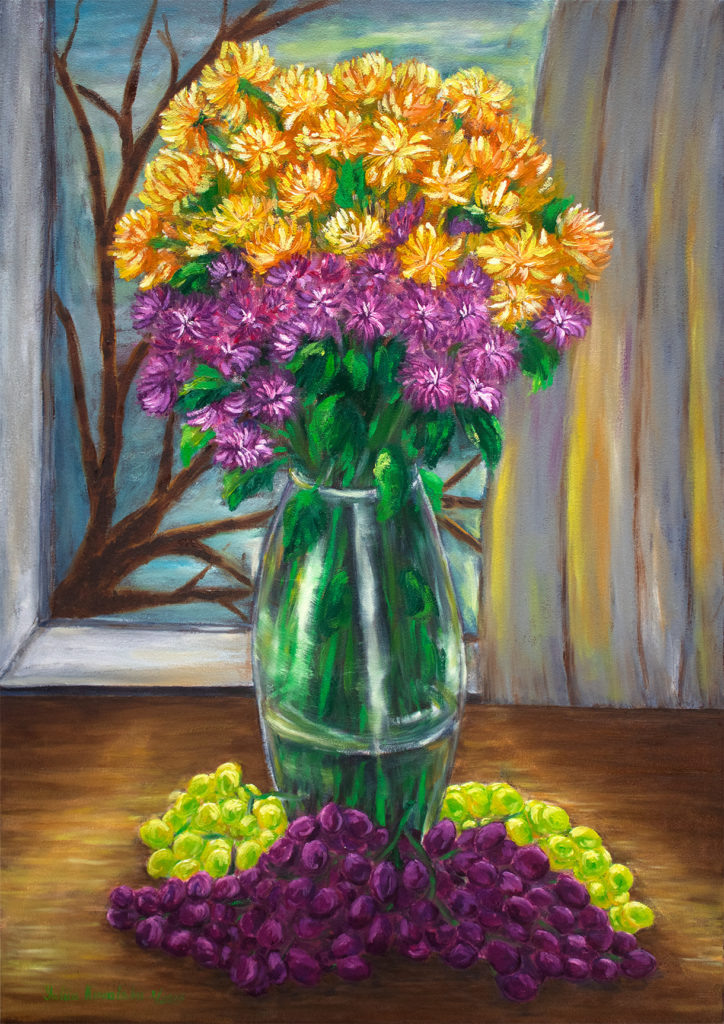
The western ray of the setting sun at the end of a short late autumn day. The sun suddenly emerged from behind the clouds at sunset and illuminated the vase of chrysanthemums standing on the table for a moment. It immediately sparkled with magical colours and seemed to hang in the air, supported by this ray. And the grapes, which I had managed to lay out on the table to make a sketch, began to radiate an unearthly glow. It was one of those rare moments of inspiration when the brushes paint themselves and the colours fall exactly as you intended from the very first stroke. After experiencing such moments, you realise that time is a relative concept. I painted this picture in two days.
The western ray
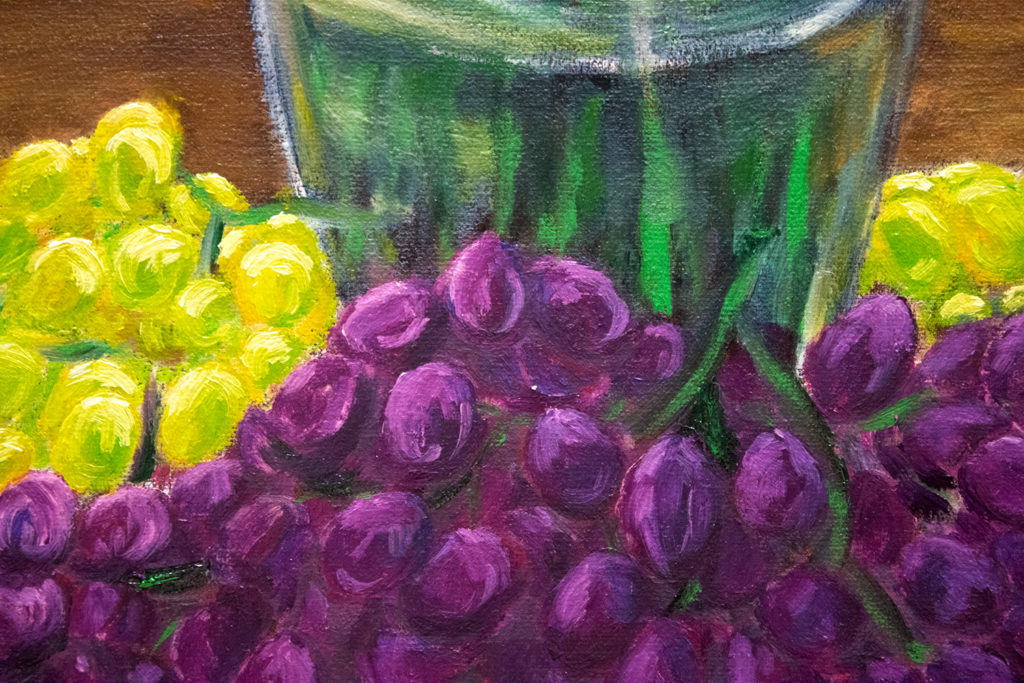
The western ray. Close-up
The western ray. Close-up
The western ray. Sidepiece. Close-up
The western ray. Close-up. Signature of the artist
The western ray. Frame option
If you are interested in this painting and would like to purchase it, please fill out and send the feedback form on the home page. You can also purchase this painting at the online galleries linked on the home page. Dispatch from Kiev (Ukraine)
TITLE: The western ray. Sunset’s shine YEAR: 2025 ARTWORK TYPE: Original Art/One of a kind DIMENSIONS: 70х50cm TECHNIQUES: Oil on acrylic undercoat RELATED THEMES: Still life art SUPPORT OR SURFACE: Canvas on the canvas-stretcher FRAMING: No CATALOGUE N: Kovalska142
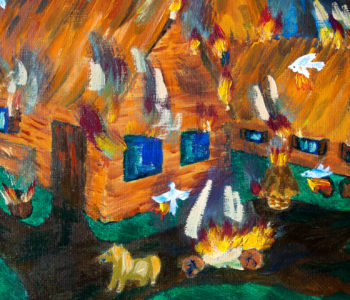
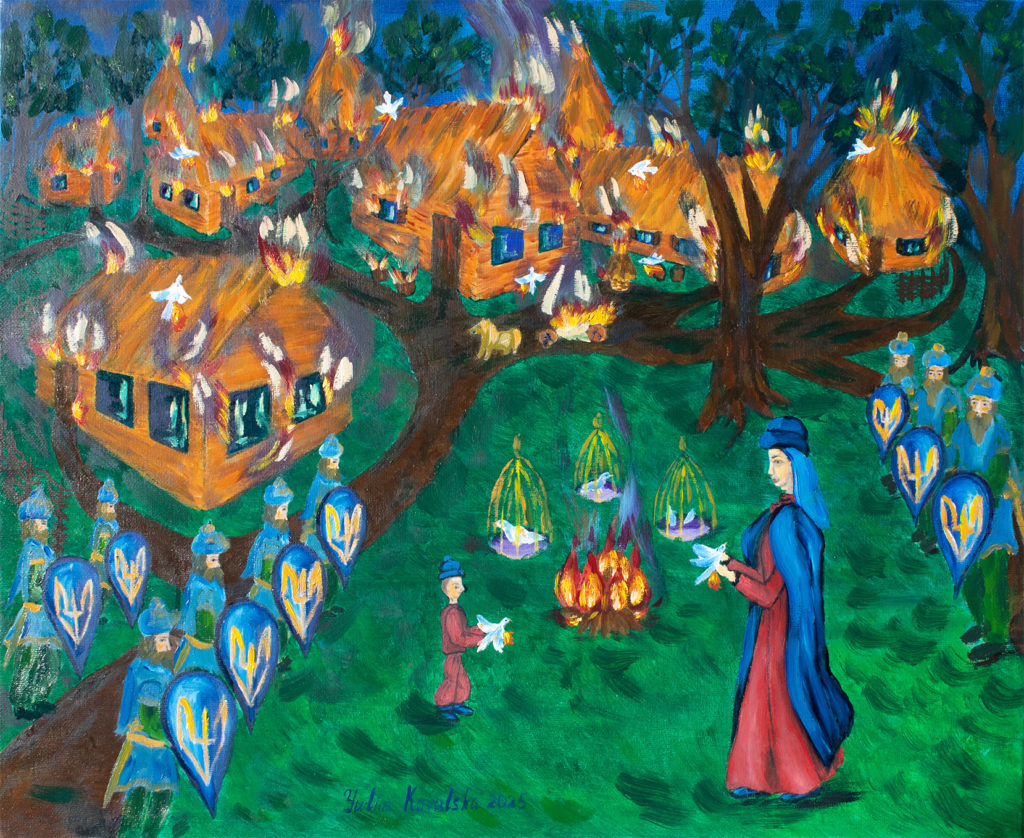
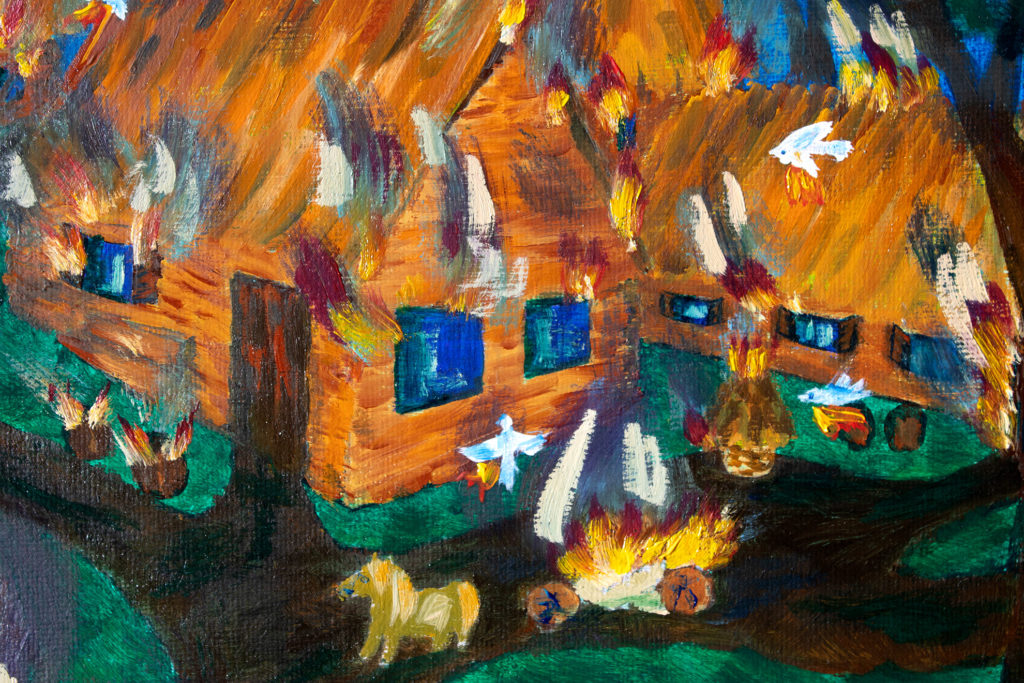
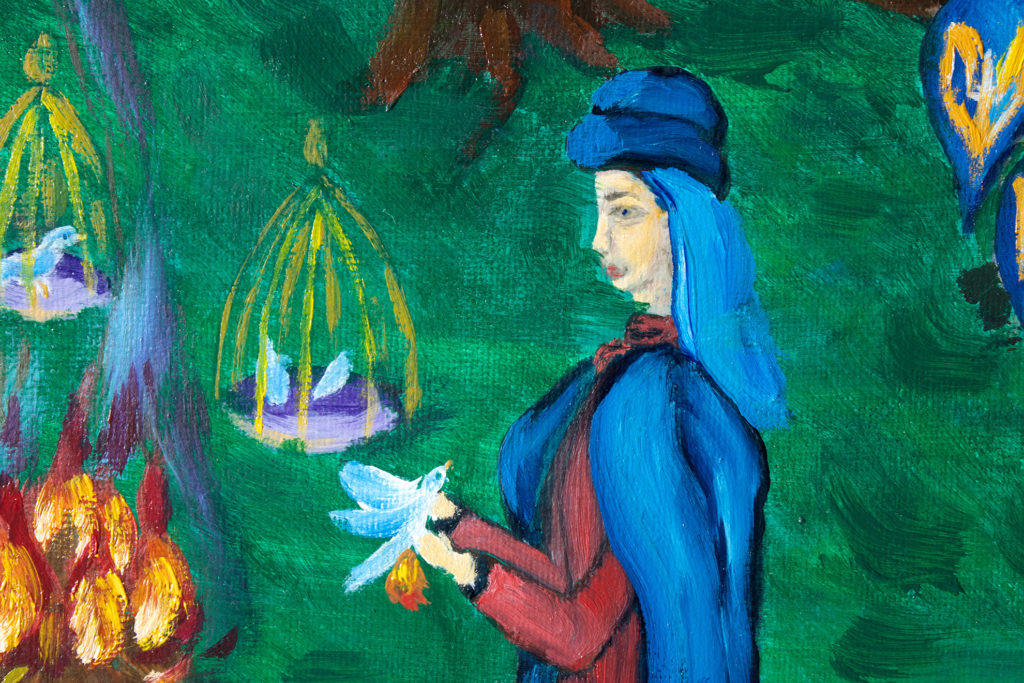
Princess Olga is a legendary woman who embodies the courage and resilience of Ukrainian women. After the death of her husband, Prince Igor, she had the strength and courage not only to raise her son, but also to take ruthless revenge for her husband’s death. The princess’s sharp mind repeatedly found the most ingenious solutions to the most critical situations of those times. According to historical records, the princess’s revenge on the Drevlyans was repeated, which clearly reflects her temperament. The first time, when after Igor’s death it was decided to marry Olga to the Drevlyan prince Mal, 20 of the ‘best men’ were sent to her, and the princess ordered them to be buried alive. The second time, Olga herself asked for the best men to be sent to her, and when the envoys arrived, they were burned in a bathhouse. The third time, using an ancient ritual called a trisna, Olga ordered the drunken Drevlyans to be killed. The fourth act of revenge took place after a year-long siege of the city of Iskoroten. Through her envoys, Olga asked for three pigeons and three sparrows from each household under the pretext of a light tribute and that the revenge was supposedly over. The Drevlyans agreed, and on the princess’s orders, they tied tinder to each bird, which they set alight when it got dark and released the birds. Thus, Iskoroten burned down, and Olga avenged the death of her husband Igor.
TITLE: Princess Olga – the fourth revenge
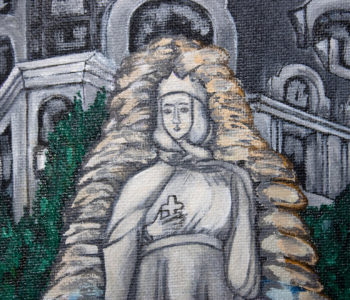
TITLE: Princess Olga – the fourth revenge. Close-up
TITLE: Princess Olga – the fourth revenge. Close-up
TITLE: Princess Olga – the fourth revenge. Close-up. Signature of the artist
TITLE: Princess Olga – the fourth revenge. Frame option
If you are interested in this painting and would like to purchase it, please fill out and send the feedback form on the home page. You can also purchase this painting at the online galleries linked on the home page. Dispatch from Kiev (Ukraine)
TITLE: Princess Olga – the fourth revenge YEAR: 2025 ARTWORK TYPE: Original Art/One of a kind DIMENSIONS: 40х50cm TECHNIQUES: Oil on acrylic undercoat RELATED THEMES: Landscape, history SUPPORT OR SURFACE: Canvas on the canvas-stretcher FRAMING: No CATALOGUE N: Kovalska136
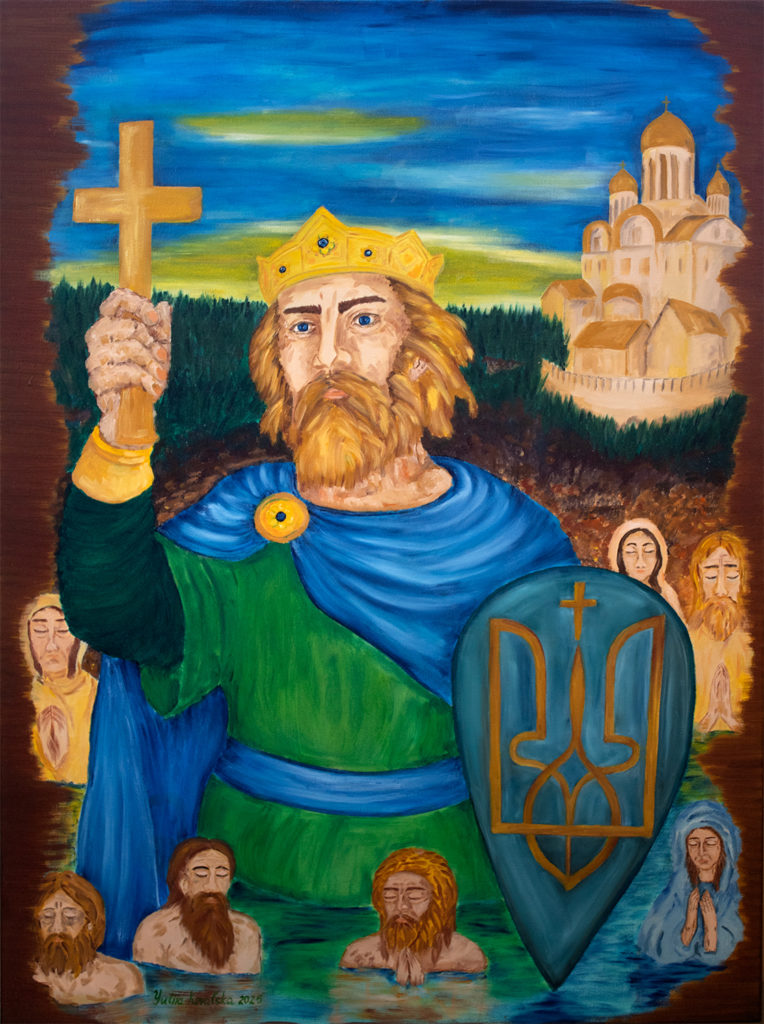
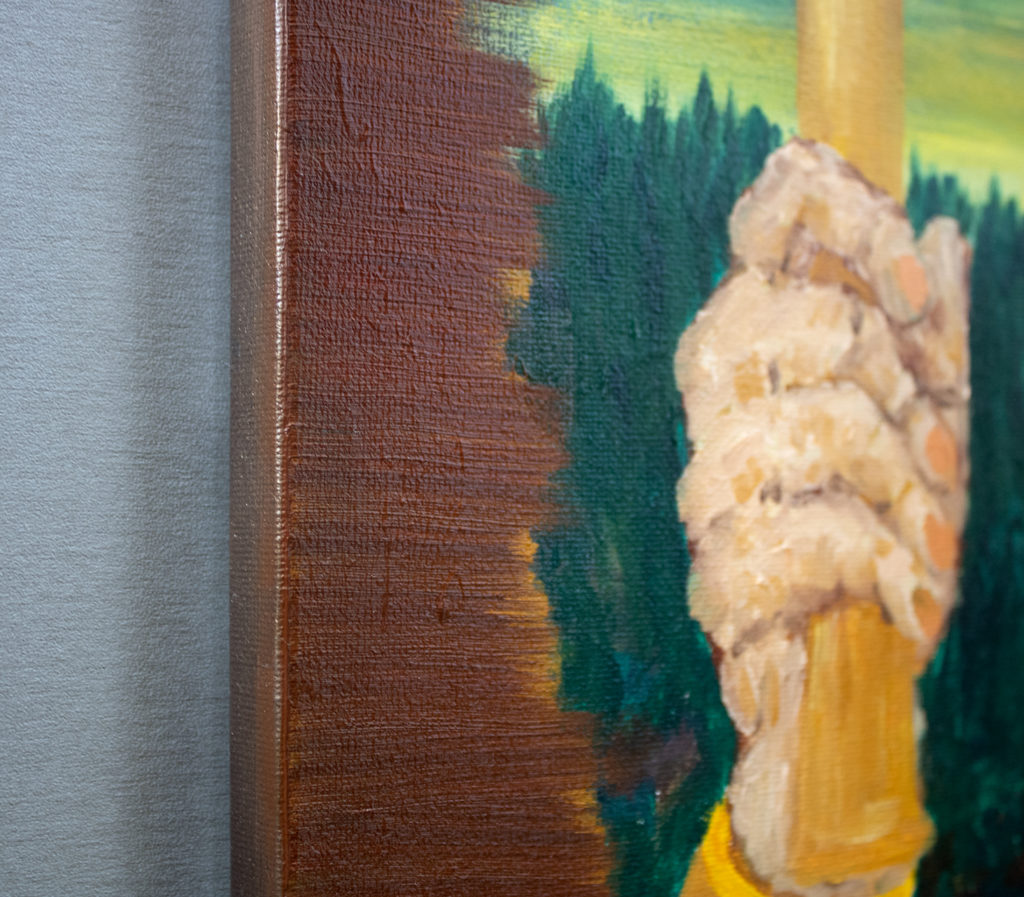
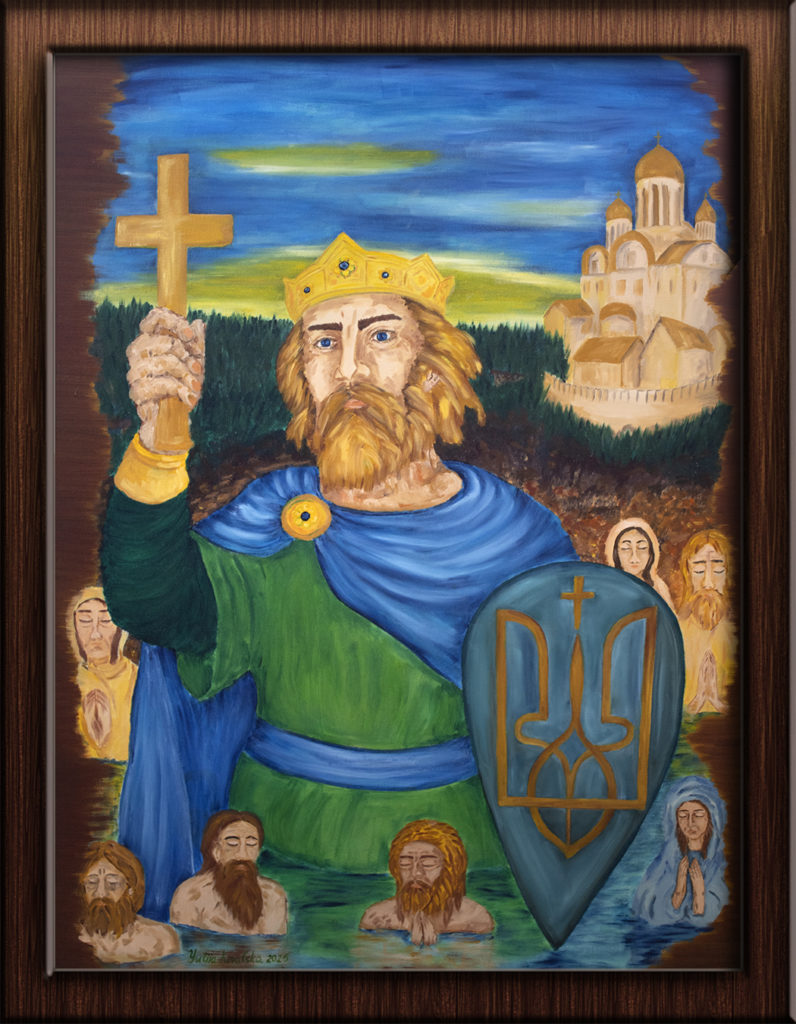
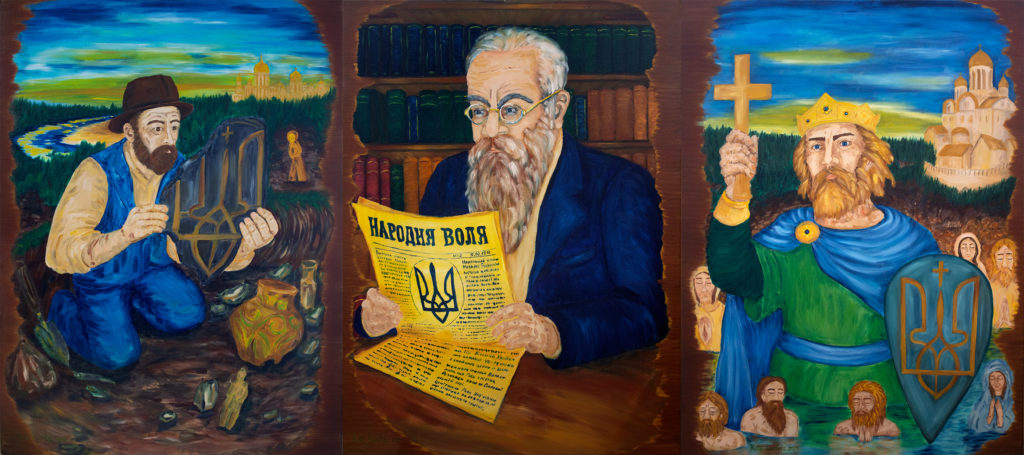
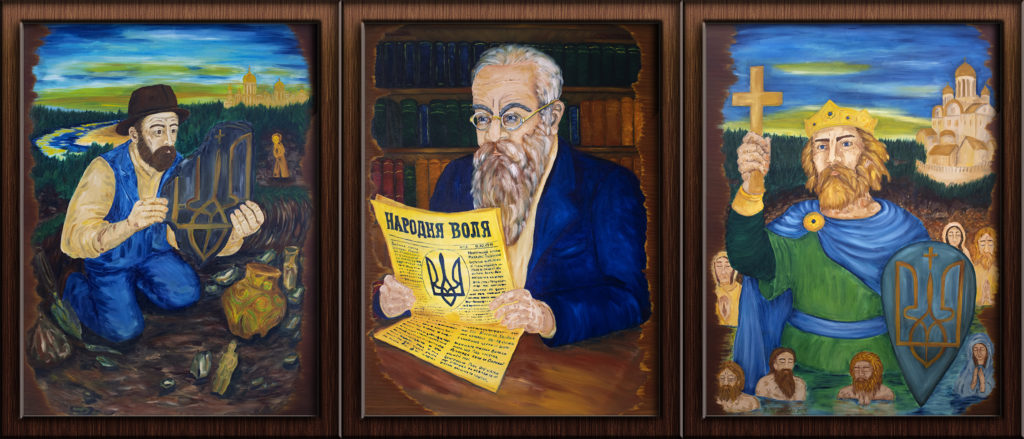
The painting, which is the right-hand panel of the triptych ‘Freedom’, depicts Grand Prince Vladimir Sviatoslavich of Kiev, under whose rule the Christianisation of Rus took place. The theme that unites the paintings in this triptych is, first and foremost, the coat of arms of our state, the continuity of generations, the continuity of history, and the interconnection of important historical events. The trident depicted on Prince Vladimir’s shield has been a symbol of our country since ancient times. Even in the days of Kievan Rus, the definition of state power and the continuity of statehood traditions, symbolised by the trident, was of great importance. The history of the trident dates back to the time of the Rurikids, who used it literally everywhere: from money to bricks for building structures. But the trident appeared much earlier on the territory of modern Ukraine. Archaeological finds indicate that the Trypillians used the trident as a sign of elders as early as the 3rd-4th centuries BC. Many different hypotheses have been put forward as to what the Ukrainian coat of arms symbolises. None of them has been fully proven, so there is still no reliable and comprehensive interpretation. A fairly common opinion is that the trident symbolises Rarok, the messenger of heavenly justice, or a falcon flying down. In many cultures, this bird was of great importance, as it was the embodiment of victory over evil, a symbol of power, indestructible strength and valour. In ancient Slavic culture, the falcon also occupied a special place at the top of the world tree. Among the various interpretations, there are other associations, including that the Ukrainian trident is an ancient religious symbol, a tripod candlestick, an anchor, an ear of wheat, a crown, a bow and arrow, and a triune sacrifice for the victory of life over death. Some experts on Ukrainian culture believe that the coat of arms of Ukraine can be deciphered as the word ‘VOLYA’ (This ancient russian word has several meanings: will, liberty, freedom), the letters of which make up the modern trident. But whatever it symbolises, the trident symbolises above all the will of the people, the indestructibility of the country, and embodies the connection between generations. Today, the trident is the coat of arms of Ukraine and has long been a symbol of the indestructibility and struggle of Ukrainians for freedom.
Prince Volodymyr — godfather of Kievan Rus
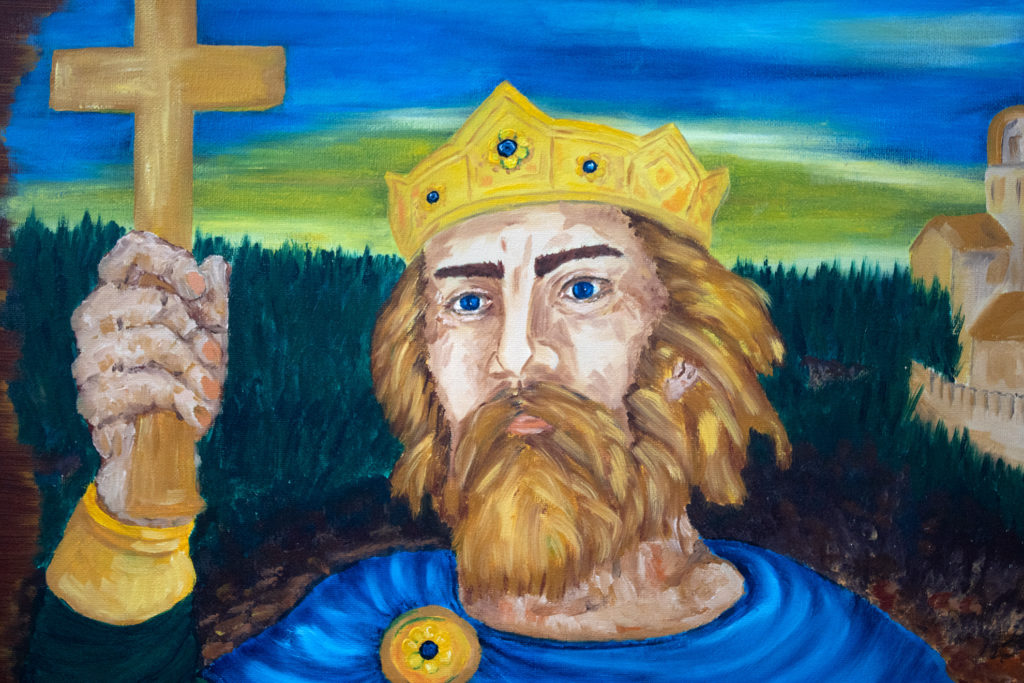
Prince Volodymyr — godfather of Kievan Rus. Close-up
Prince Volodymyr — godfather of Kievan Rus. Sidepiece. Close-up
Prince Volodymyr — godfather of Kievan Rus. Close-up. Signature of the artist
Prince Volodymyr — godfather of Kievan Rus. Frame option
If you are interested in this painting and would like to purchase it, please fill out and send the feedback form on the home page. You can also purchase this painting at the online galleries linked on the home page. Dispatch from Kiev (Ukraine)
TITLE: Prince Volodymyr — godfather of Kievan Rus Triptych “Freedom”. Right part YEAR: 2025 ARTWORK TYPE: Original Art/One of a kind DIMENSIONS: 60х80cm TECHNIQUES: Oil RELATED THEMES: Portrait, history SUPPORT OR SURFACE: Canvas on the canvas-stretcher FRAMING: No CATALOGUE N: Kovalska133r
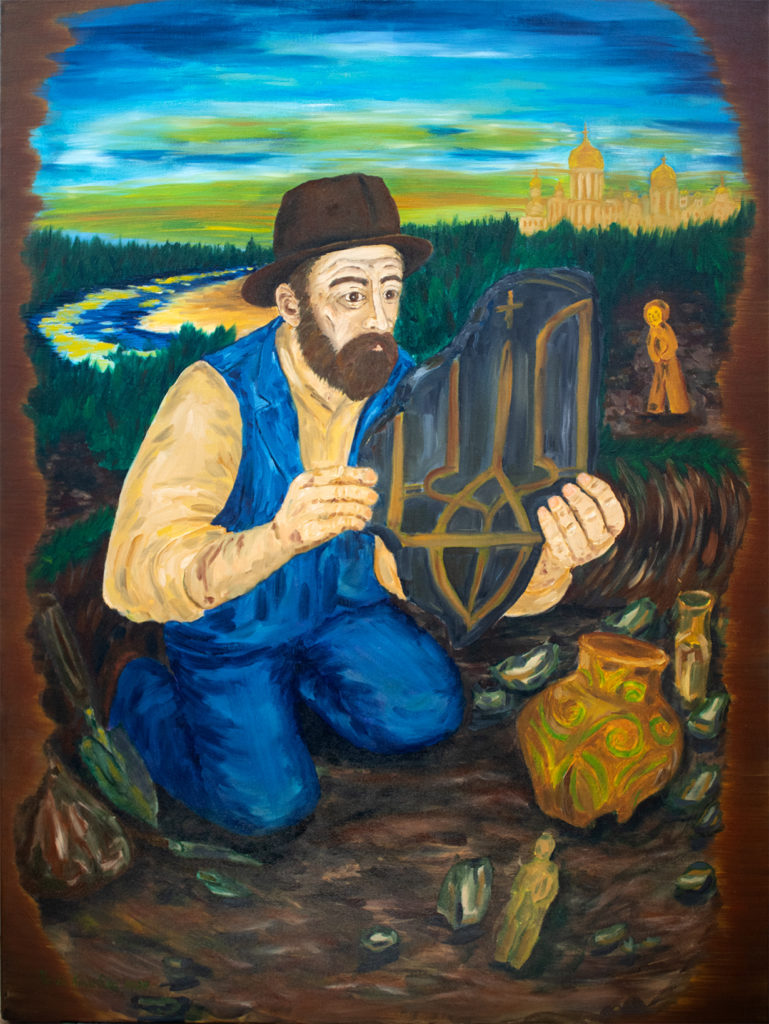
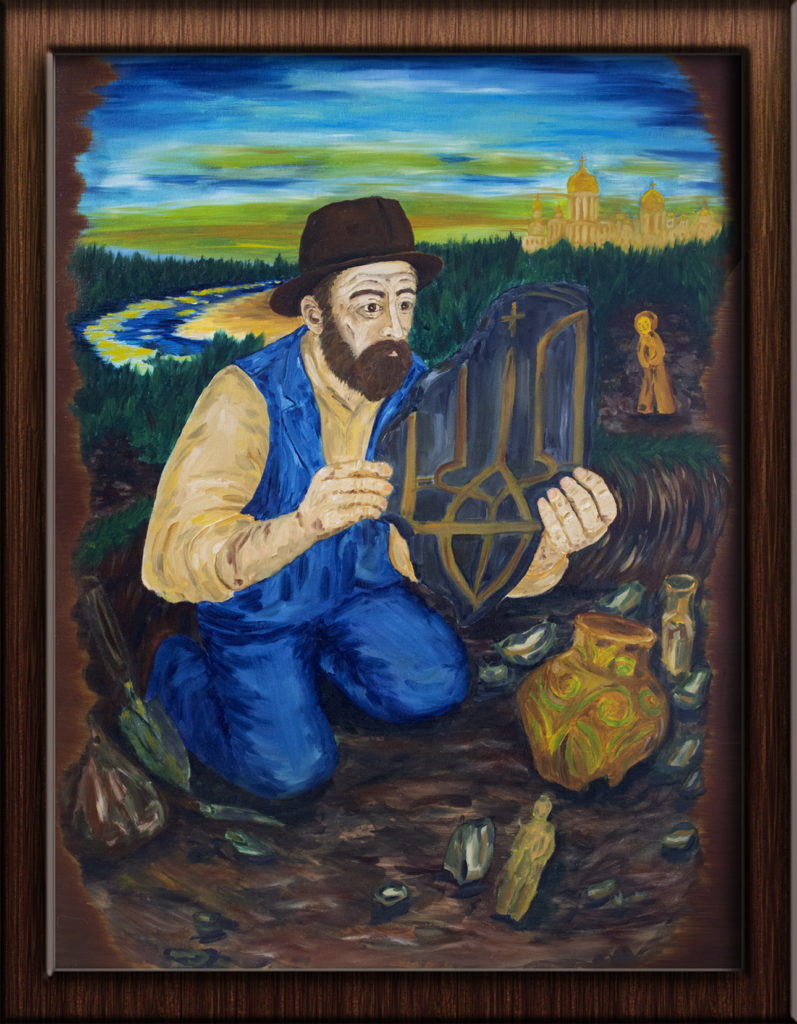
Vikentiy Khvoika (real name Čeněk Chvojka, Czech) was a self-taught Russian archaeologist of Czech origin, one of the founders of Ukrainian archaeology, the discoverer of the Trypillian culture in the Kyiv region, and a researcher of the Scythian, Zarubintsy (3rd century BC — 4th century AD), Chernyakhov (2nd—7th centuries) and early Slavic cultures. In 1907, during archaeological excavations in Kiev, Chvojka stumbled upon a unique find — an ancient plinth with a trident engraved on it. It was the symbol of Vladimir Sviatoslavich, which later became the coat of arms of independent Ukraine. The painting, which is the left part of the triptych ‘Freedom’, depicts the moment when the ancient symbol of princely power was found. The theme that unites the paintings in this triptych is, first and foremost, the coat of arms of our state, the continuity of generations, the continuity of history, and the interconnection of important historical events. The trident has been a symbol of our country since ancient times. Even in the days of Kievan Rus, the definition of state power and the continuity of statehood traditions, symbolised by the trident, was of great importance. The history of the trident dates back to the time of the Rurikids, who used it literally everywhere: from money to bricks for building structures. But the trident appeared much earlier on the territory of modern Ukraine. Archaeological finds indicate that the Trypillians used the trident as a sign of elders as early as the 3rd-4th centuries BC. Many different hypotheses have been put forward as to what the Ukrainian coat of arms symbolises. None of them has been fully proven, so there is still no reliable and comprehensive interpretation. A fairly common opinion is that the trident symbolises Rarok, the messenger of heavenly justice, or a falcon flying down. In many cultures, this bird was of great importance, as it was the embodiment of victory over evil, a symbol of power, indestructible strength and valour. In ancient Slavic culture, the falcon also occupied a special place at the top of the world tree. Among the various interpretations, there are other associations, including that the Ukrainian trident is an ancient religious symbol, a tripod candlestick, an anchor, an ear of wheat, a crown, a bow and arrow, and a triune sacrifice for the victory of life over death. Some experts on Ukrainian culture believe that the coat of arms of Ukraine can be deciphered as the word ‘VOLYA’ (This ancient russian word has several meanings: will, liberty, freedom), the letters of which make up the modern trident. But whatever it symbolises, the trident symbolises above all the will of the people, the indestructibility of the country, and embodies the connection between generations. Today, the trident is the coat of arms of Ukraine and has long been a symbol of the indestructibility and struggle of Ukrainians for freedom.
Vikentiy Khvoyka. Kyiv artefacts from the princely era
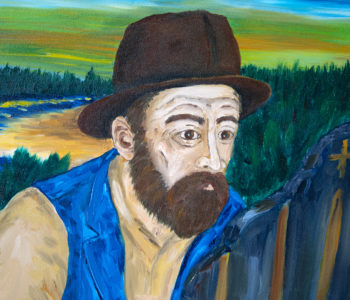
Vikentiy Khvoyka. Kyiv artefacts from the princely era. Close-up
Vikentiy Khvoyka. Kyiv artefacts from the princely era. Close-up
Vikentiy Khvoyka. Kyiv artefacts from the princely era. Sidepiece. Close-up
Vikentiy Khvoyka. Kyiv artefacts from the princely era. Close-up. Signature of the artist
Vikentiy Khvoyka. Kyiv artefacts from the princely era. Frame option
If you are interested in this painting and would like to purchase it, please fill out and send the feedback form on the home page. You can also purchase this painting at the online galleries linked on the home page. Dispatch from Kiev (Ukraine)
TITLE: Vikentiy Khvoyka. Kyiv artefacts from the princely era Triptych “Freedom”. Left part YEAR: 2025 ARTWORK TYPE: Original Art/One of a kind DIMENSIONS: 60х80cm TECHNIQUES: Oil RELATED THEMES: Portrait, history SUPPORT OR SURFACE: Canvas on the canvas-stretcher FRAMING: No CATALOGUE N: Kovalska133l
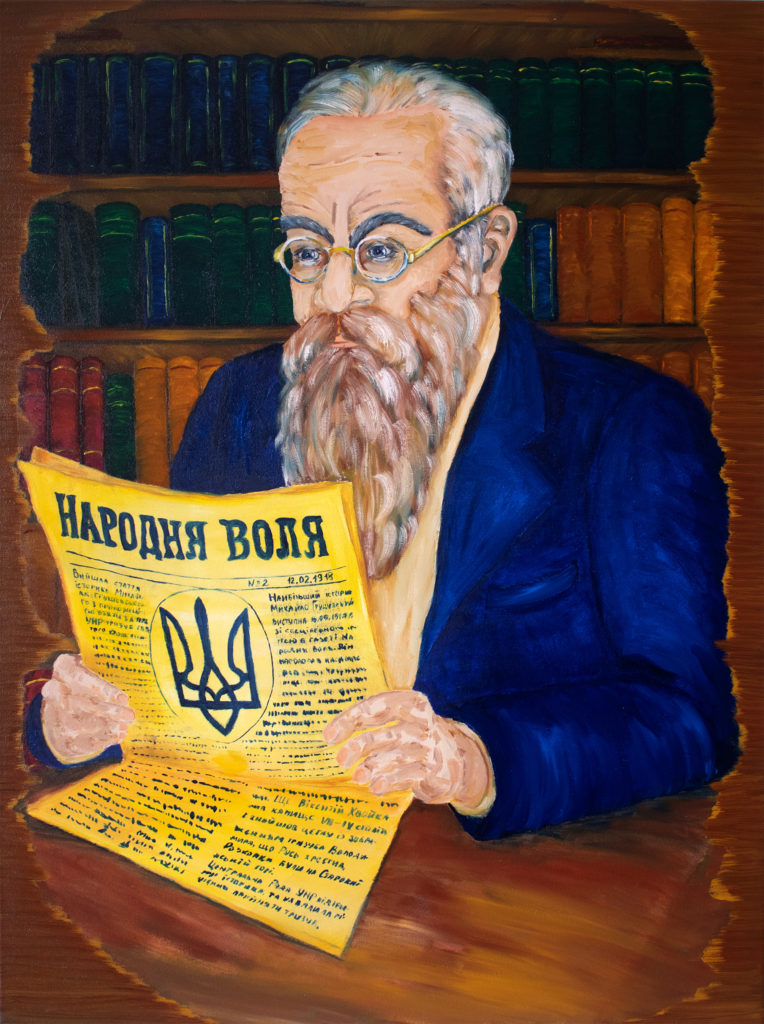
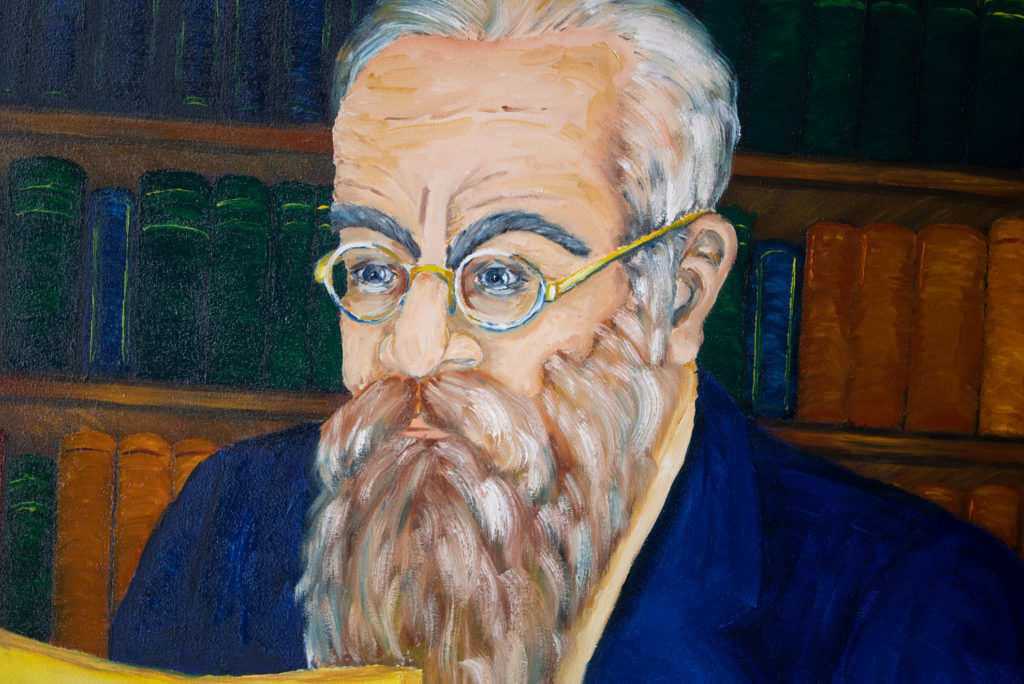
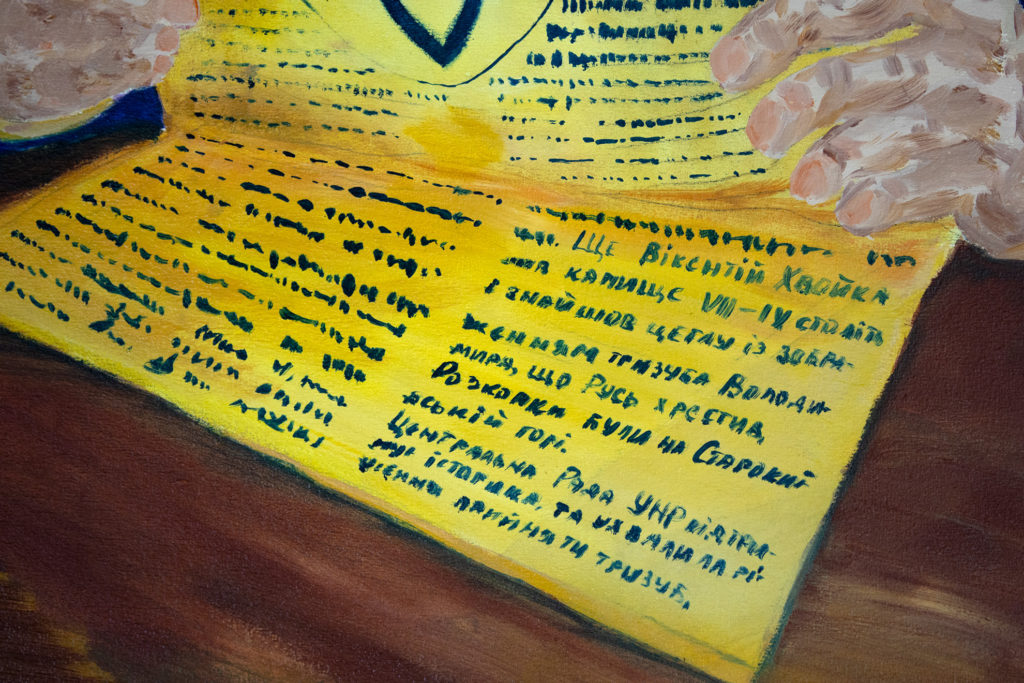
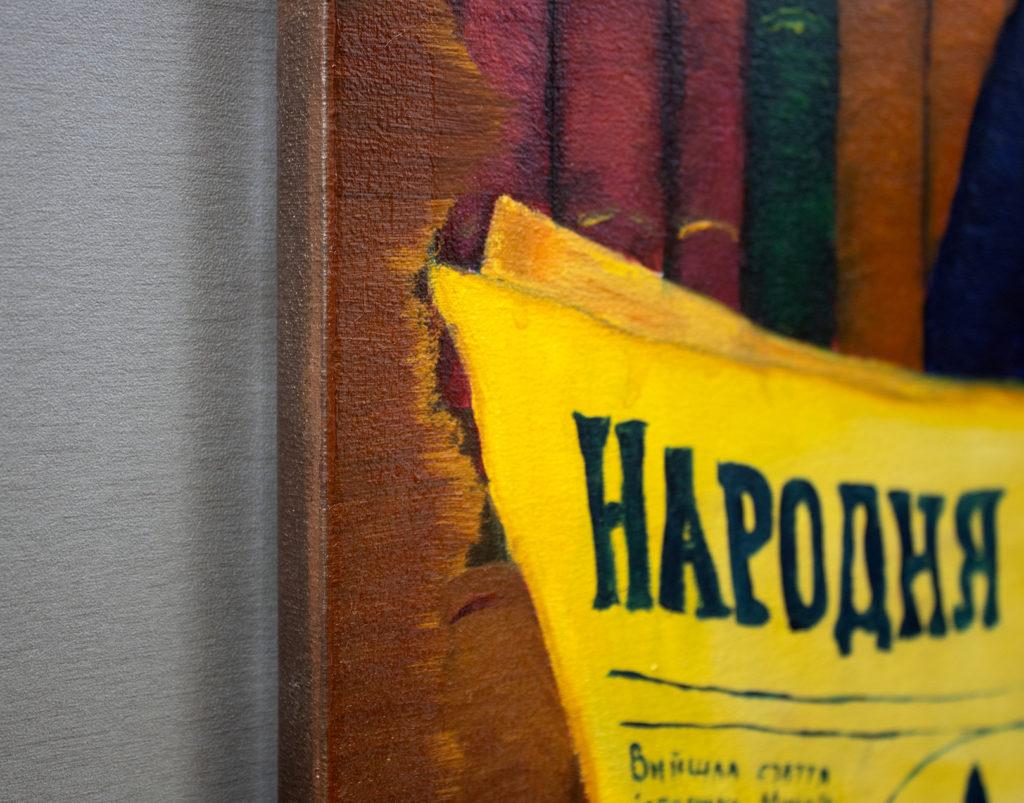
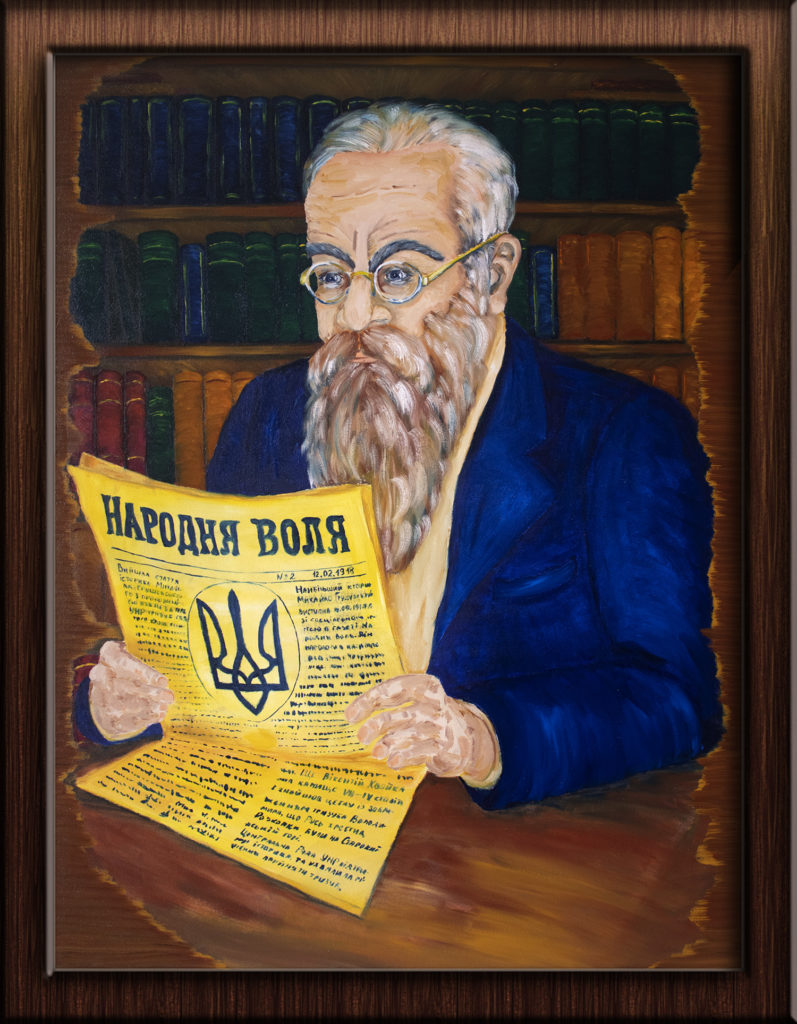
The painting, which is the central part of the triptych ‘Freedom’, depicts Mykhailo Hrushevsky, a Ukrainian historian, public figure and politician. He was the chairman of the Central Rada of the Ukrainian People’s Republic (1917-1918). At Hrushevsky’s suggestion, on 12 (25) February, at a meeting of the Small Rada in Korosten, the trident was approved as the coat of arms of the Ukrainian People’s Republic, and it became the coat of arms of independent Ukraine in 1991. The theme that unites the paintings in this triptych is, first and foremost, the coat of arms of our state, the continuity of generations, the continuity of history, and the interconnection of important historical events. The trident has been a symbol of our country since ancient times. Even in the days of Kievan Rus, the definition of state power and the continuity of statehood traditions, symbolised by the trident, was of great importance. The history of the trident dates back to the time of the Rurikids, who used it literally everywhere: from money to bricks for building structures. But the trident appeared much earlier on the territory of modern Ukraine. Archaeological finds indicate that the Trypillians used the trident as a sign of elders as early as the 3rd-4th centuries BC. Many different hypotheses have been put forward as to what the Ukrainian coat of arms symbolises. None of them has been fully proven, so there is still no reliable and comprehensive interpretation. A fairly common opinion is that the trident symbolises Rarok, the messenger of heavenly justice, or a falcon flying down. In many cultures, this bird was of great importance, as it was the embodiment of victory over evil, a symbol of power, indestructible strength and valour. In ancient Slavic culture, the falcon also occupied a special place at the top of the world tree. Among the various interpretations, there are other associations, including that the Ukrainian trident is an ancient religious symbol, a tripod candlestick, an anchor, an ear of wheat, a crown, a bow and arrow, and a triune sacrifice for the victory of life over death. Some experts on Ukrainian culture believe that the coat of arms of Ukraine can be deciphered as the word ‘VOLYA’ (This ancient russian word has several meanings: will, liberty, freedom), the letters of which make up the modern trident. But whatever it symbolises, the trident symbolises above all the will of the people, the indestructibility of the country, and embodies the connection between generations. Today, the trident is the coat of arms of Ukraine and has long been a symbol of the indestructibility and struggle of Ukrainians for freedom.
Mykhailo Hrushevsky. A historical view of the political unity of the nation
Mykhailo Hrushevsky. A historical view of the political unity of the nation. Close-up
Mykhailo Hrushevsky. A historical view of the political unity of the nation. Close-up
Mykhailo Hrushevsky. A historical view of the political unity of the nation. Sidepiece. Close-up
Mykhailo Hrushevsky. A historical view of the political unity of the nation. Close-up. Signature of the artist
Mykhailo Hrushevsky. A historical view of the political unity of the nation. Frame option
If you are interested in this painting and would like to purchase it, please fill out and send the feedback form on the home page. You can also purchase this painting at the online galleries linked on the home page. Dispatch from Kiev (Ukraine)
TITLE: Mykhailo Hrushevsky. A historical view of the political unity of the nation Triptych “Freedom”. Central part YEAR: 2025 ARTWORK TYPE: Original Art/One of a kind DIMENSIONS: 60х80cm TECHNIQUES: Oil RELATED THEMES: Portrait, history SUPPORT OR SURFACE: Canvas on the canvas-stretcher FRAMING: No CATALOGUE N: Kovalska133c
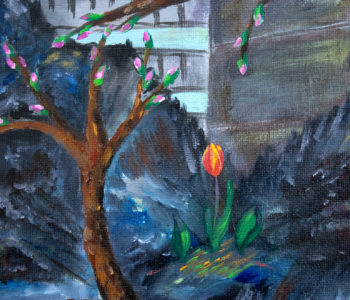
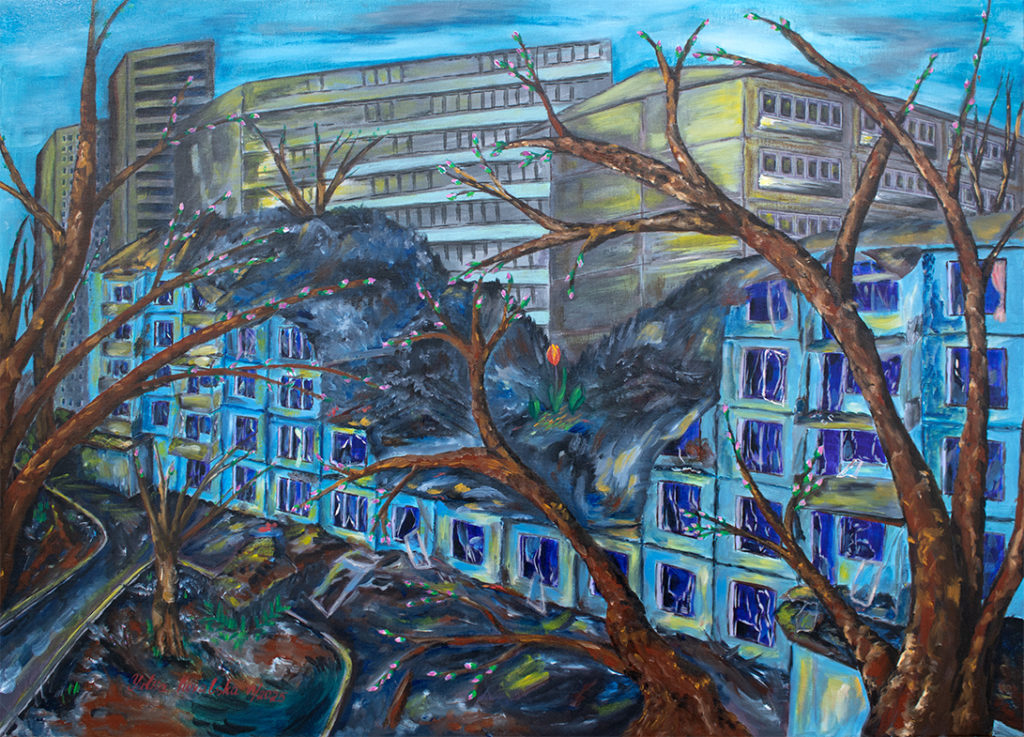
The painting continues my collection ‘War in Ukraine’. And the main theme in it is the hope for dawn after a long, long night, which is evidenced by the flowers ready to blossom on the trees and a blossoming tulip on the ruins of a house. And the first rays of the rising sun are already visible on the walls of the empty and ruined houses.
A little more — and the flowers on the trees will bloom…
A little more — and the flowers on the trees will bloom… Close-up
A little more — and the flowers on the trees will bloom… Close-up
A little more — and the flowers on the trees will bloom… Close-up. Signature of the artist
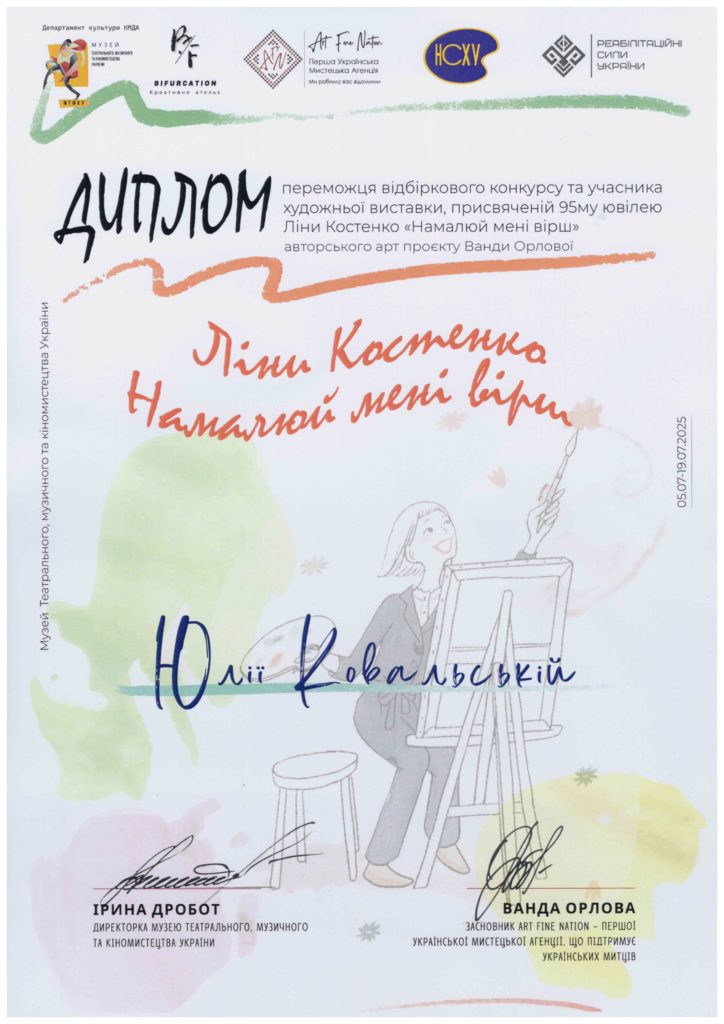
Diploma of the winner of the qualifying competition and participant in the art exhibition dedicated to the anniversary of Lina Kostenko, ‘Draw Me a Poem,’ an author’s project by Vanda Orlova.
I painted this picture in the format of an art battle organized by the Ukrainian art association Art Fine Nation. The competition was called ‘Paint me a poem by Lina Kostenko’. The artists chose a poem from those proposed by Art Fine Nation and an art pair of artists who chose the same poem. Then, for 10 days, the pair of artists painted paintings (each of them their own) on the theme of the poem. The paintings then took part in a selection competition, and the winners will be presented at the collective exhibition in Kiev.
A little more, a little more – and the flowers on the trees will bloom, and the will fly around like a rhizomes’ dream.
War paints watercolour paintings with blood. Its palette – is the ashes of fires.
Its landscape – is the ruins of neighbourhoods. Empty streets are faded pastels.
Unless some tulips suddenly sprout somewhere through the groaning rubble.
Lina Kostenko
The painting is the winner of the qualifying competition and participant in the art exhibition dedicated to the anniversary of Lina Kostenko, ‘Draw Me a Poem,’ an author’s project by Vanda Orlova
The painting was featured in the art exhibition ‘Draw Me a Poem by Lina Kostenko,’ held in Kyiv in the hall of the multifunctional centre of the Pechersk District State Administration. (Historical Centre of Kyiv)
If you are interested in this painting and would like to purchase it, please fill out and send the feedback form on the home page. You can also purchase this painting at the online galleries linked on the home page. Dispatch from Kiev (Ukraine)
TITLE: A little more — and the flowers on the trees will bloom… COLLECTION: War in Ukraine YEAR: 2025 ARTWORK TYPE: Original Art/One of a kind DIMENSIONS: 70 х 50 sm TECHNIQUES: Oil, Acrylic RELATED THEMES: City landscape, War SUPPORT OR SURFACE: Canvas on the canvas-stretcher FRAMING: No CATALOGUE N: Kovalska131
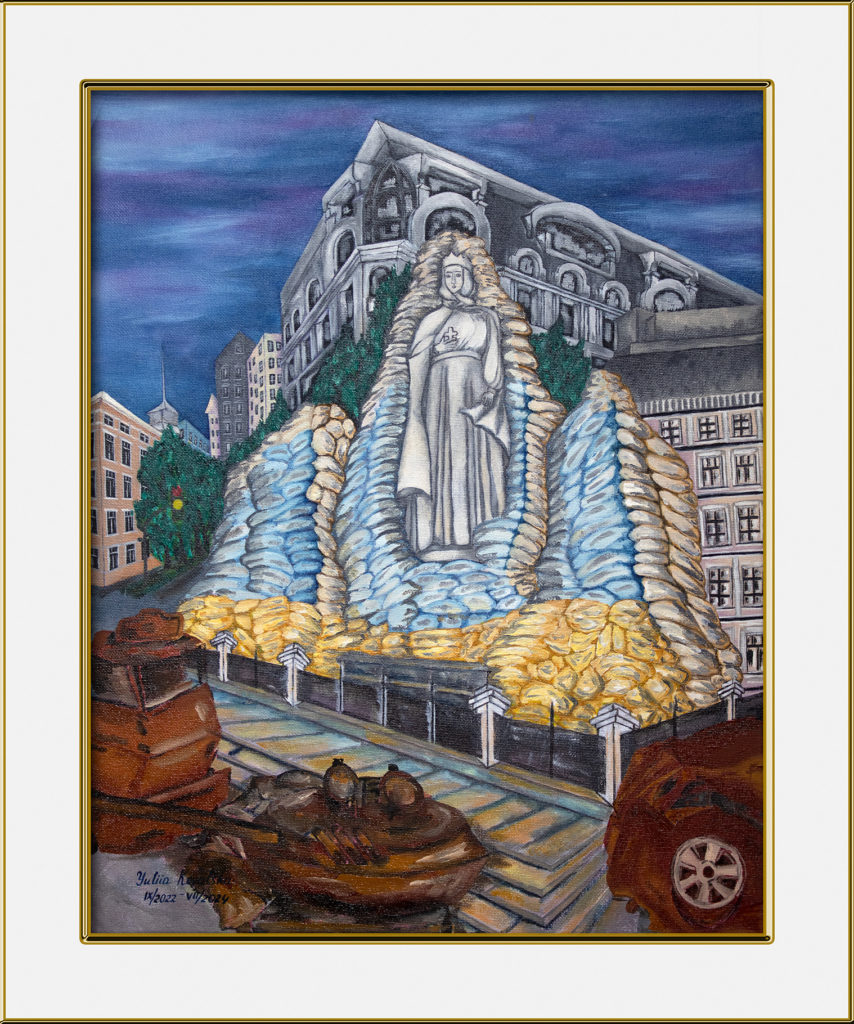
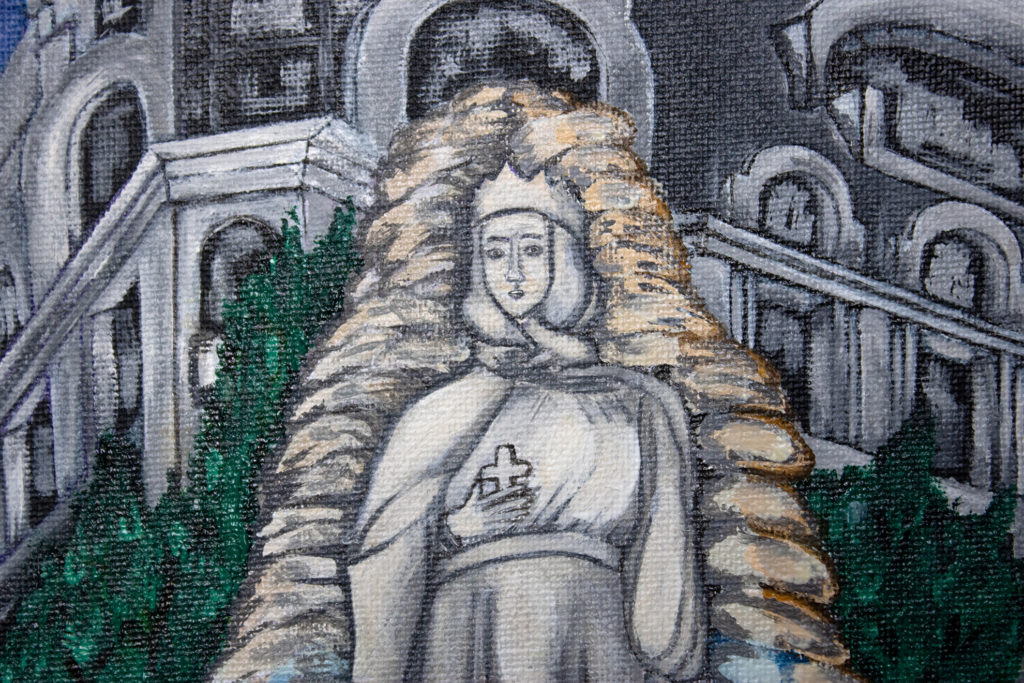
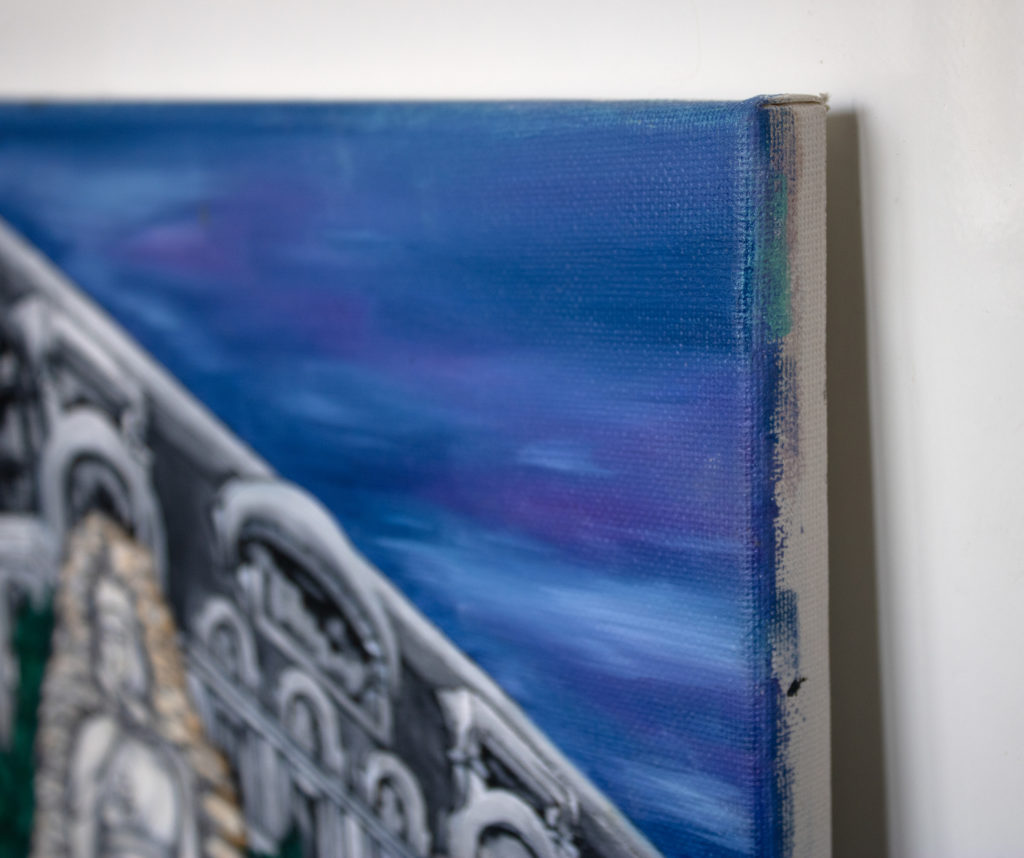
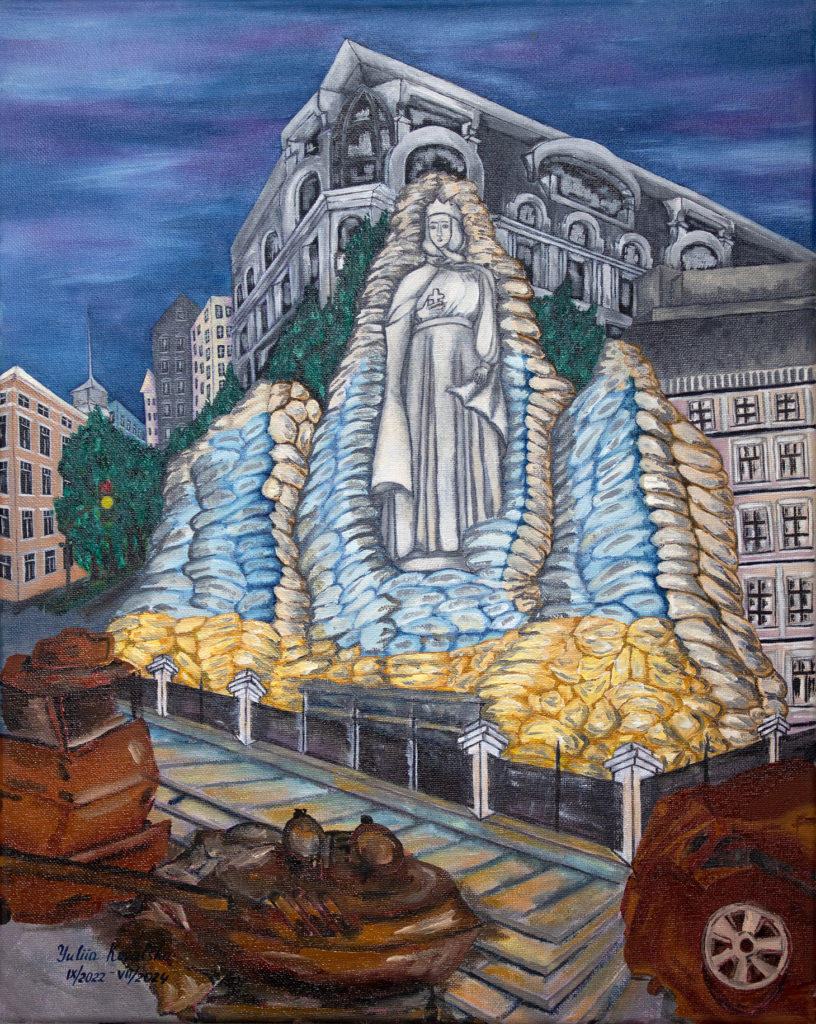
Princess Olga ascended the throne after the death of Prince Igor Rurikovich and was the de facto ruler of Kievan Rus’ from 944 to 964. Olga is immortalised not only in the history of Ukraine and the world, but also in a monument erected in her honour in 1911 on St. Michael’s Square in Kyiv, sculpted by I. Kavaleridze and P. Snitkin. A wise, far-sighted, fearless, decisive, invincible ruler according to the chronicle, she was canonised as an equal to the apostles by the Orthodox Church for accepting and spreading Christianity and building churches… The beginning of 2022, the Russian invasion, did Olga prevent the occupiers from breaking through to Kyiv? Surrounded by sandbags, the pedestal is ready to withstand a siege in the very heart of the capital, where on 21 May 2022 an exhibition of equipment destroyed in fierce battles on the approaches to the capital opened. What is this? A symbolic coincidence or a new legend about a powerful ruler who once avenged her husband’s death?
Princess Olga in defence of the capital. Frame option
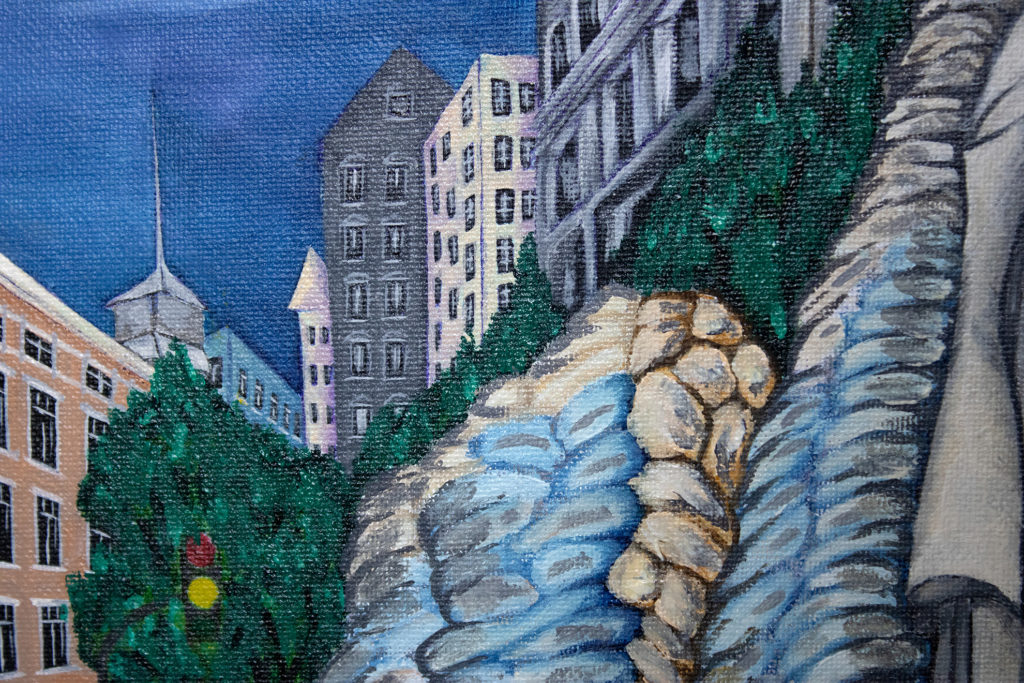
Princess Olga in defence of the capital. Close-up
Princess Olga in defence of the capital. Close-up
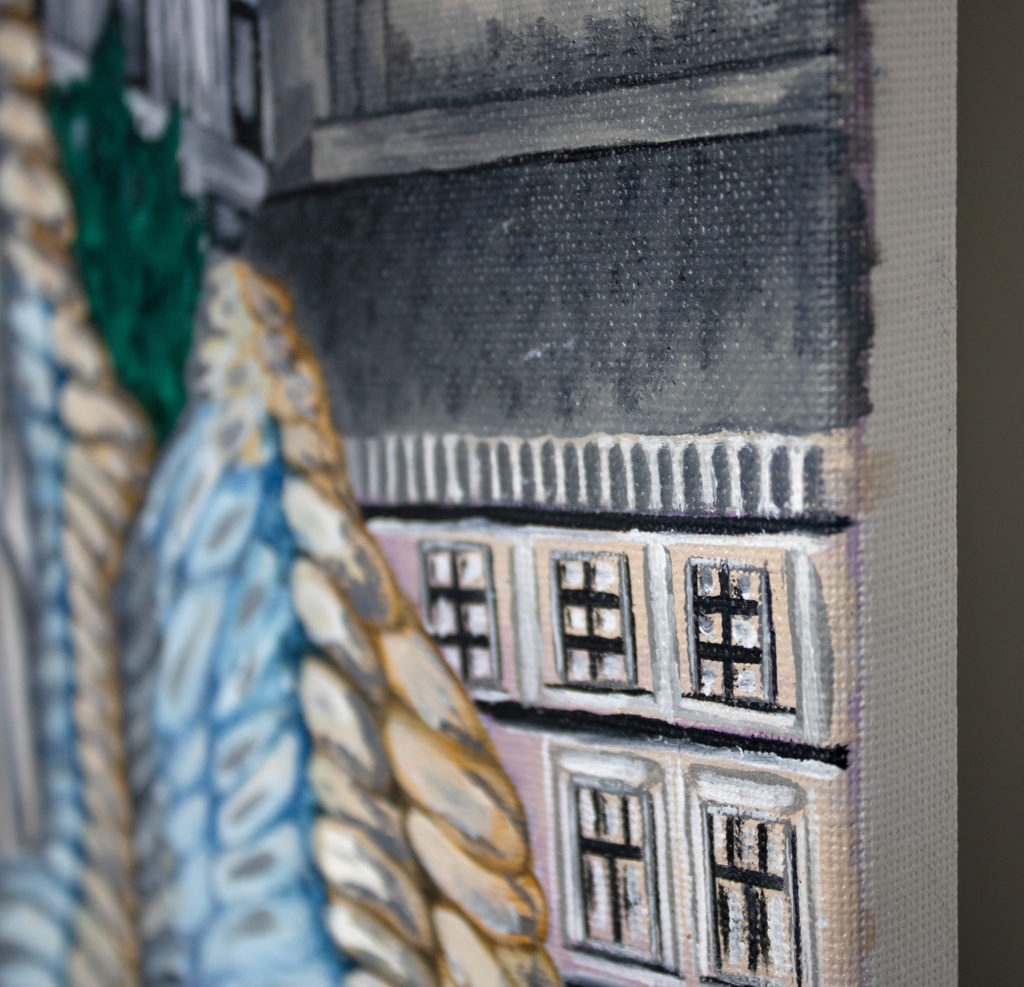
Princess Olga in defence of the capital. Sidepiece. Close-up
Princess Olga in defence of the capital. Sidepiece. Close-up
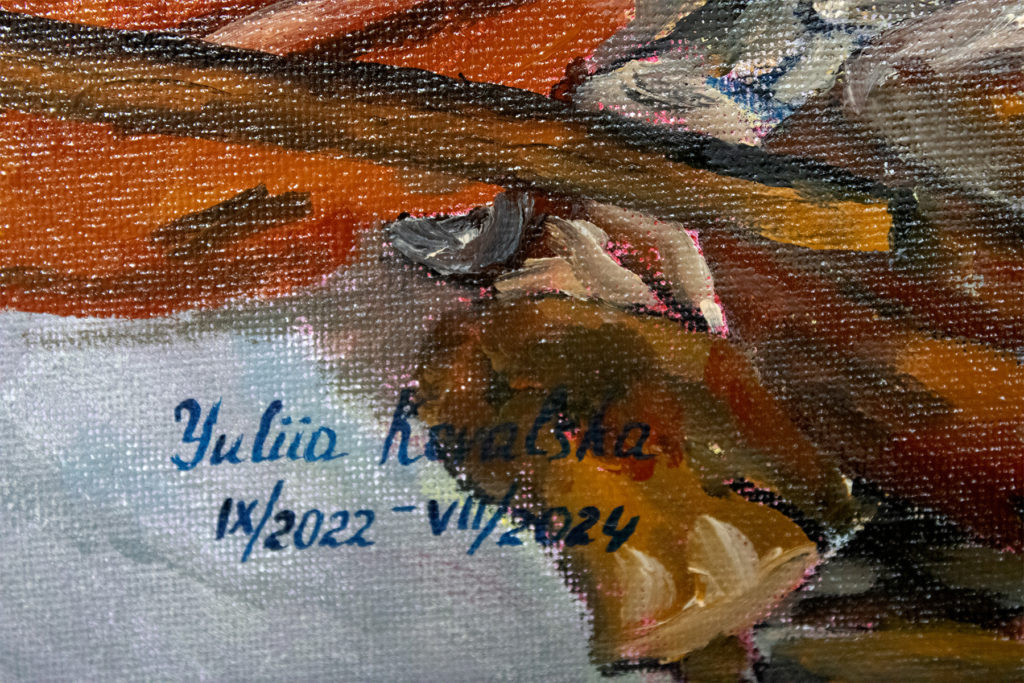
Princess Olga in defence of the capital. Close-up. Signature of the artist
Princess Olga in defence of the capital. Backside
Princess Olga in defence of the capital
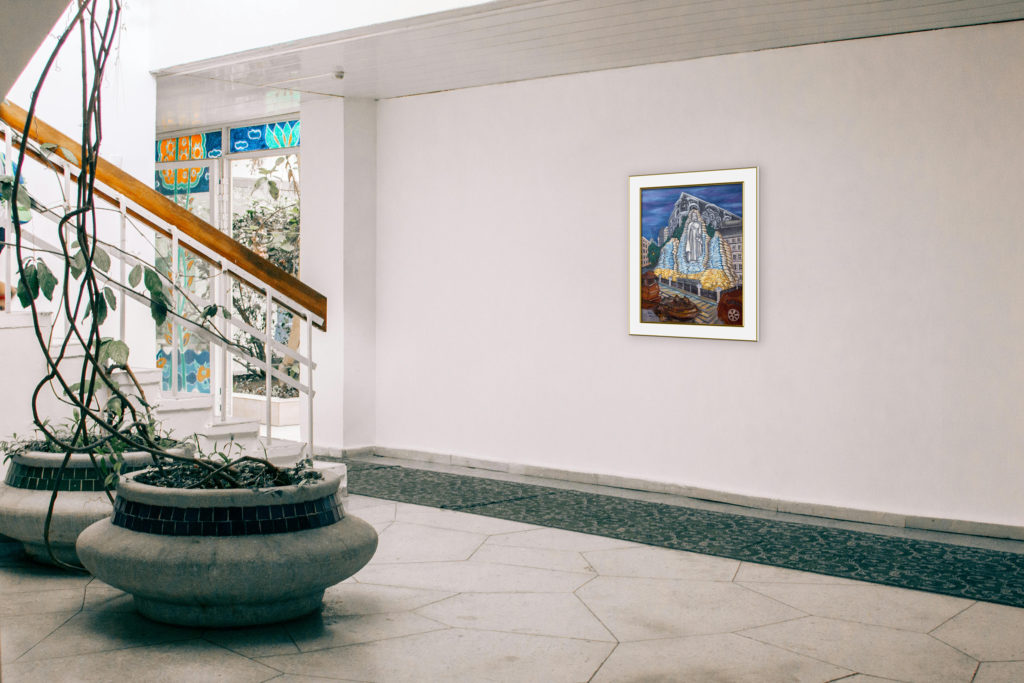
Princess Olga in defence of the capital. Interior: hall with the picture on the wall
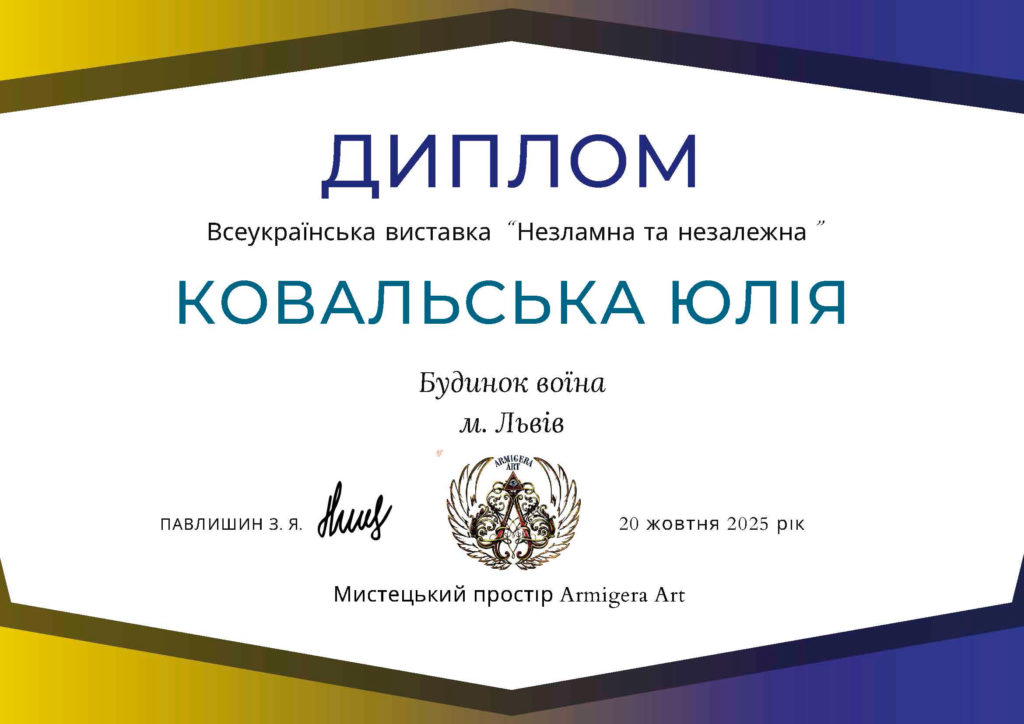
Diploma of participation in the All-Ukrainian Art Exhibition ’Unbreakable and Independent’
The painting is the participant of All-Ukrainian painting exhibition ’Unbreakable and Independent’. The exhibition was located in the House of Warrior, Lviv.
If you are interested in this painting and would like to purchase it, please fill out and send the feedback form on the home page. You can also purchase this painting at the online galleries linked on the home page. Dispatch from Kiev (Ukraine)
TITLE: Princess Olga in defence of the capital COLLECTION: War in Ukraine YEAR: 2022/2024 ARTWORK TYPE: Original Art/One of a kind DIMENSIONS: 40х50сm TECHNIQUES: Oil on acrylic undercoat RELATED THEMES: City landscape, War SUPPORT OR SURFACE: Canvas on the canvas-stretcher FRAMING: No CATALOGUE N: Kovalska092
 Landscape